Waves: Characteristics, Classification and Applications
Explore the concept of waves, how they are generated, their types and characteristics, and their importance in science and everyday life including applications such as remote sensing.
Introduction
Waves are an important concept in physics that help explain many natural and technological phenomena occurring around us. Many forms of energy travel through space or matter in the form of waves.
Light from the Sun takes about 8 minutes to reach Earth as a wave traveling through space!
In everyday life, waves are responsible for many experiences and technologies we use.
Examples of waves in daily life
- We hear sounds because sound waves travel through the air and reach our ears.
- We see objects because light waves travel from objects to our eyes.
- Radio and television signals reach our devices through electromagnetic waves.
- Water waves occur in oceans, lakes, and rivers due to disturbances in water.
Earthquake waves (seismic waves) can travel through the entire Earth and help scientists study its internal structure.
Waves are also associated with several natural phenomena such as:
- Ocean waves caused by wind
- Earthquake waves travelling through the Earth
- Vibrations in air, water, and solid materials
Because of these properties, waves play an important role in:
- Communication systems
- Energy transfer
- Scientific observations
- Environmental monitoring
- Medical technology
3.2.1 Meaning of a Wave
A wave is defined as:
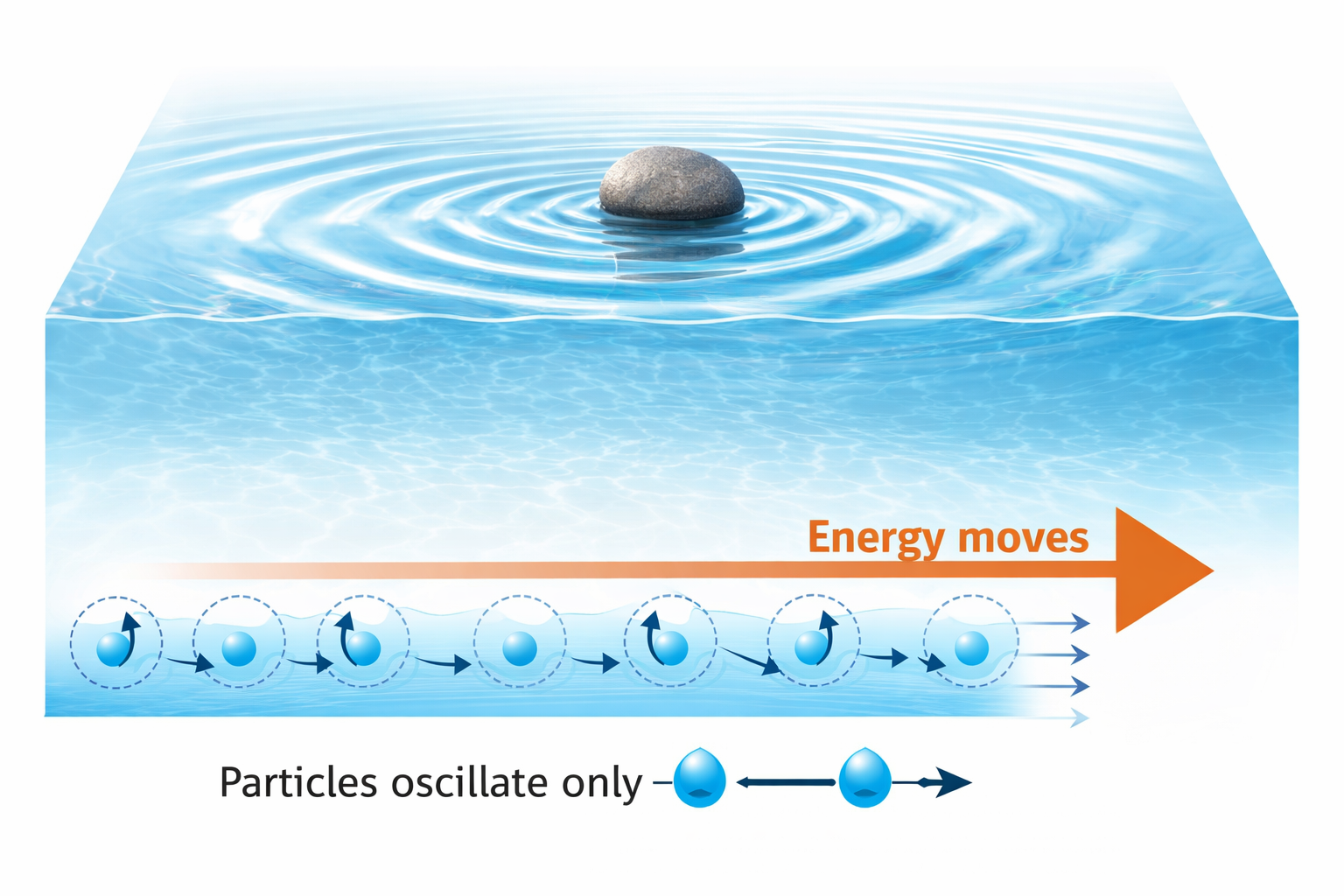
A disturbance that transfers energy from one place to another without the permanent movement of matter.
Waves can travel through empty space—this is how sunlight and radio signals reach Earth without needing any material medium.
This means that waves carry energy through a medium or through space, but the particles of the medium do not travel long distances.
Important ideas in the definition
- A wave involves a disturbance or vibration.
- Waves transfer energy from one place to another.
- The particles of the medium only vibrate around their original positions.
- The energy moves, not the matter itself.
In ocean waves, water appears to move forward, but each water particle mainly moves in a circular motion around its original position.
Example
When a stone is dropped into a basin of water, ripples spread outward from the point where the stone hits the water.
- The water particles move up and down.
- The particles do not travel outward with the ripples.
- The energy of the disturbance spreads outward across the surface of the water.
3.2.2 Generation (Formation) of Waves in Nature
Waves are produced whenever a disturbance or vibration occurs in a medium.
Even a small vibration, like plucking a guitar string, can generate waves that travel through air and reach your ears as sound.
This disturbance causes particles in the medium to move and transfer energy to neighbouring particles.
Examples of wave generation
1. Water waves
When a stone or object falls into water, it disturbs the surface and produces circular ripples that spread outward.
2. Sound waves
When objects vibrate (such as vocal cords, speakers, or musical instruments), they cause nearby air particles to vibrate and produce sound waves.
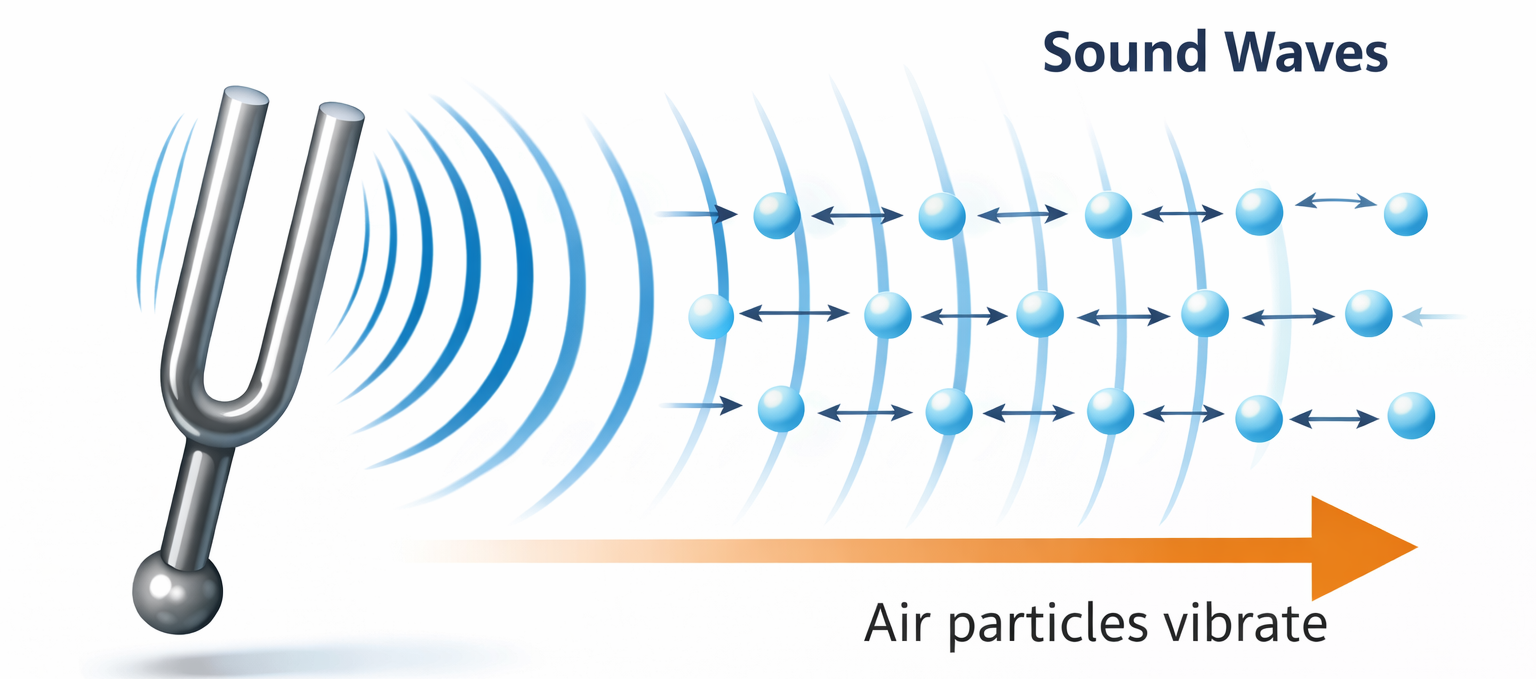
Sound cannot travel in a vacuum because there are no particles to vibrate and carry the wave.
3. Rope or spring waves
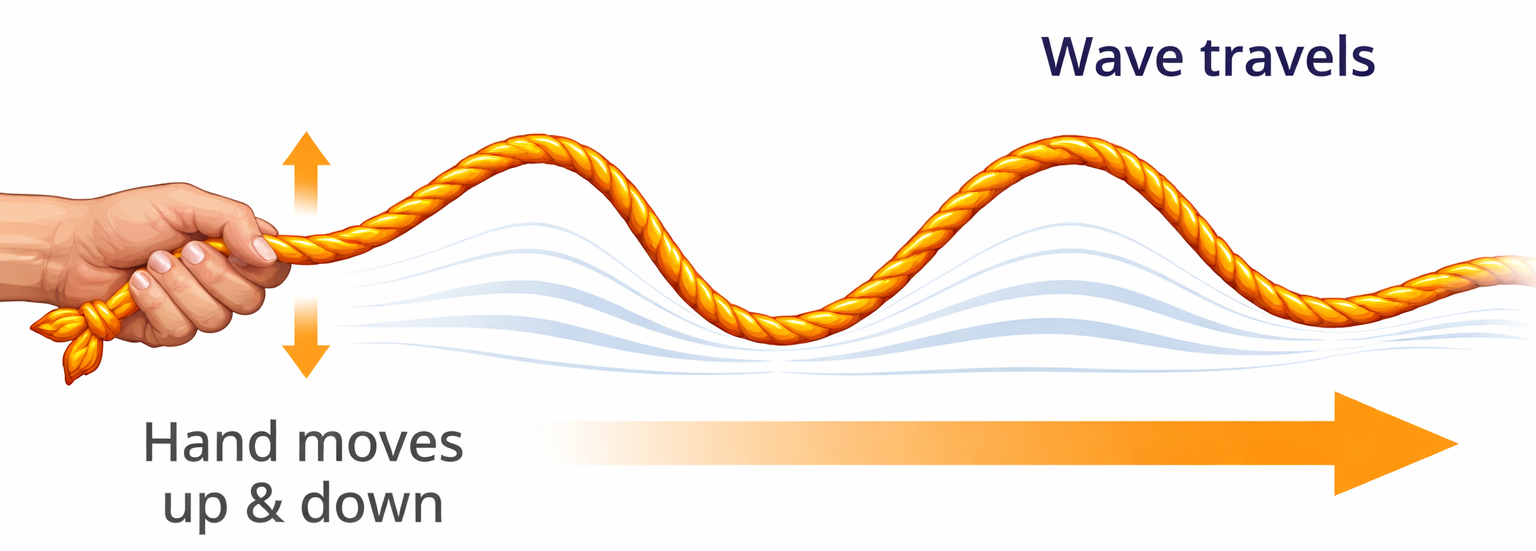
Moving one end of a rope or slinky spring causes waves to travel along the rope or spring.
4. Ocean waves
Strong winds blowing across the ocean transfer energy to the water surface, causing large ocean waves.
3.2.3 Classification of Waves
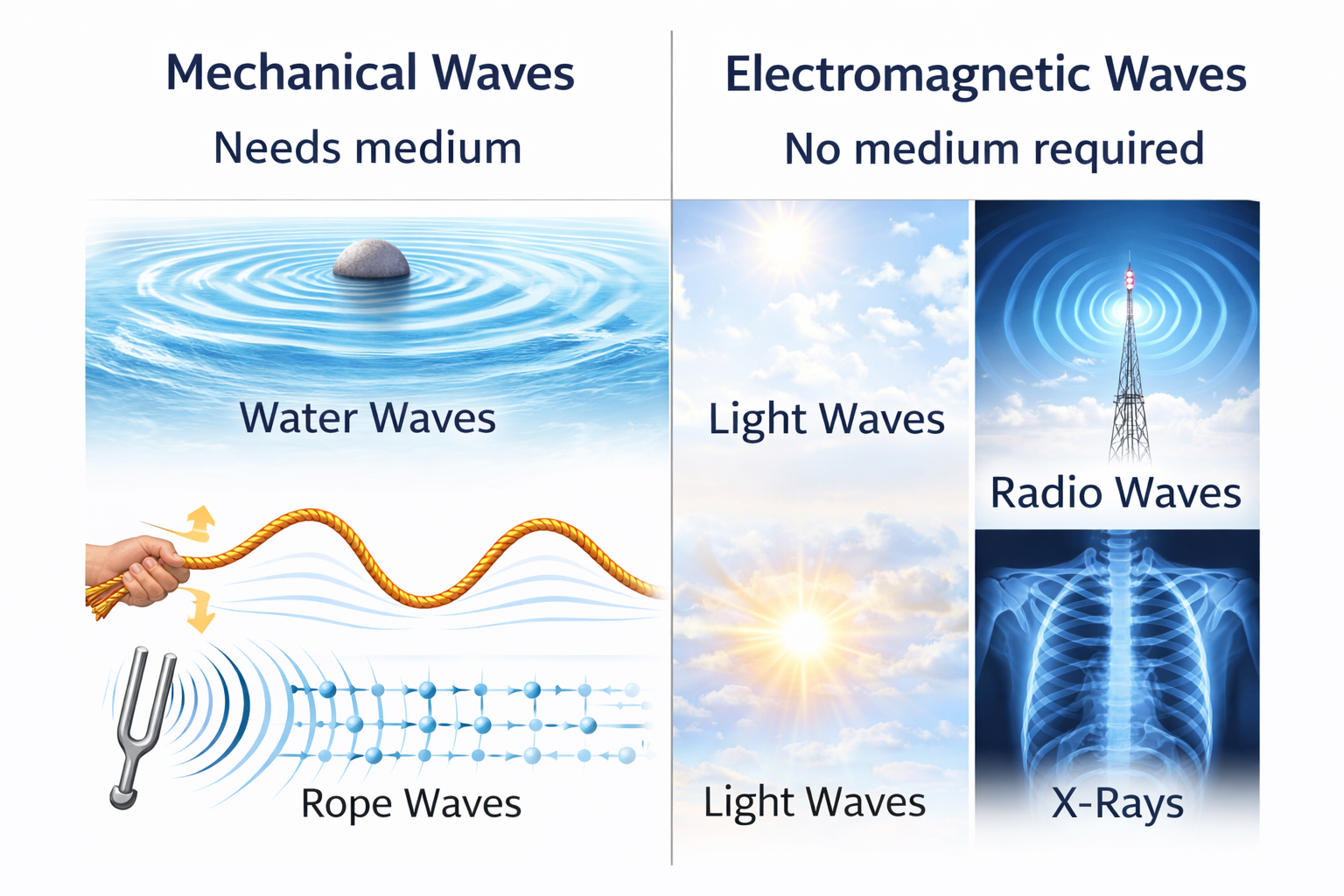
Waves can be classified into two main categories based on whether they require a medium for transmission.
i) Mechanical waves
ii) Electromagnetic waves
Light from the Sun is an electromagnetic wave, which is why it can travel through empty space to reach Earth.
Mechanical Waves
Mechanical waves require a material medium in order to travel.
A medium can be: Solid, Liquid or Gas
Mechanical waves cannot travel in a vacuum because they require particles of a medium to transmit energy.
Examples of mechanical waves
- Water waves
- Sound waves
- Waves on a rope
- Waves in a slinky spring
These waves move because particles of the medium vibrate and transfer energy to neighbouring particles.
Electromagnetic Waves
Electromagnetic waves do not require a medium to travel.
They can move through empty space (vacuum).
These waves consist of oscillating electric and magnetic fields.
Examples of electromagnetic waves
- Light waves
- Radio waves
- Microwaves
- X-rays
- Infrared waves
Electromagnetic waves are important in many technologies including:
- Communication systems
- Satellite transmission
- Medical imaging
- Radar systems
X-rays, used in hospitals to view bones, are also a type of electromagnetic wave.
Demonstration of Wave Generation
Several simple experiments can be used to demonstrate how waves are produced and how they travel.
Waves Using a Slinky Spring
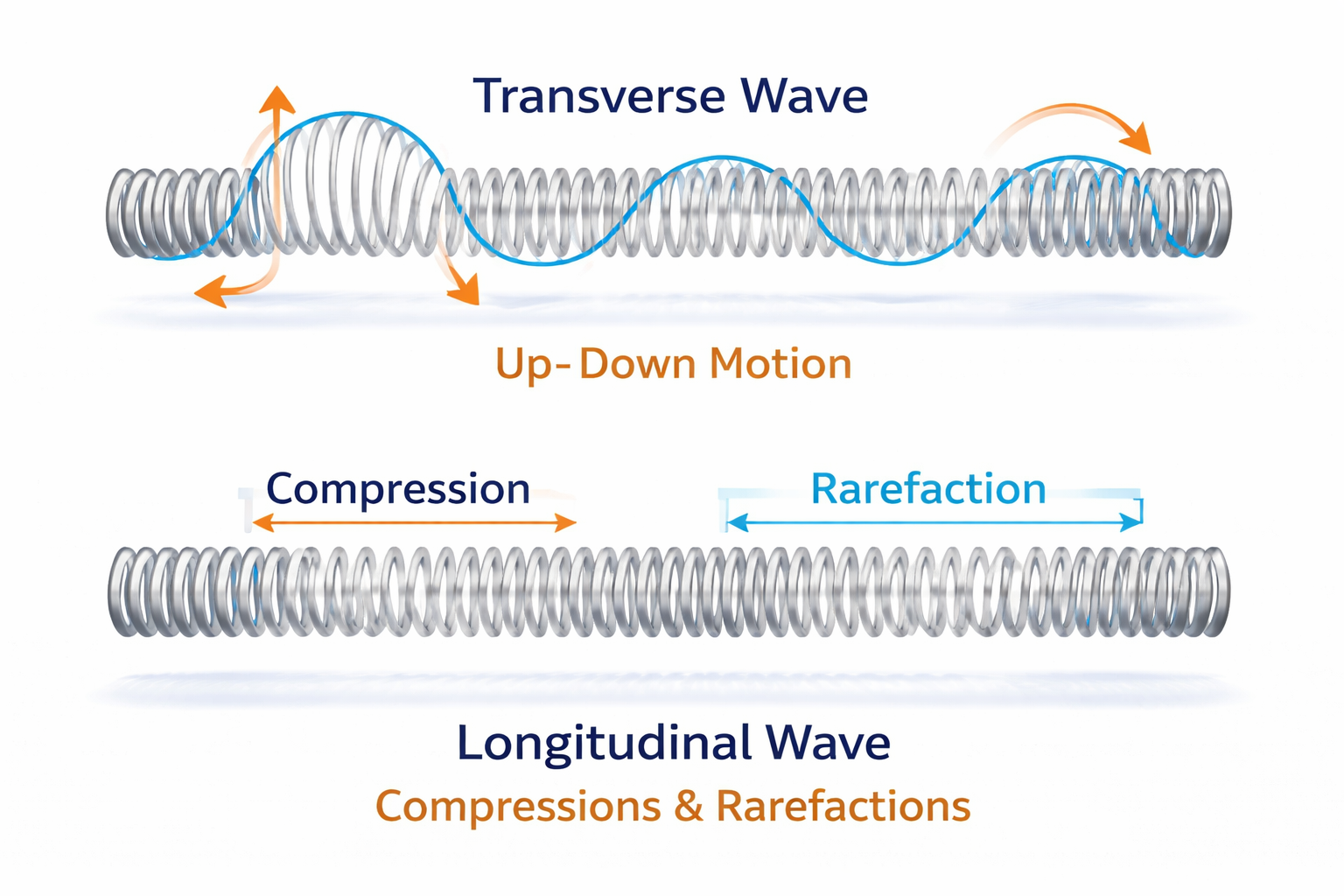
A slinky spring can be used to demonstrate both transverse waves and longitudinal waves.
Procedure
- Fix one end of the slinky spring to a solid support or hold it firmly.
- Stretch the spring slightly along the ground.
- First method
- Move the free end up and down.
Observation
- Humps and valleys move along the spring.
- This demonstrates a transverse wave.
Second method
- Push and pull the spring forward and backward.
Observation
- Regions where the coils come close together and spread apart move along the spring.
- This demonstrates a longitudinal wave.
Waves Using a Rope
Procedure
- Tie one end of a rope to a pole or fixed support.
- Move the free end of the rope up and down.
Observation
- Waves travel along the rope as humps and valleys.
- The rope particles move up and down, while the wave energy moves along the rope.
Waves Using Water
Procedure
- Fill a basin with water.
- Drop a small stone gently into the centre of the basin.
Observation
- Circular ripples spread outward across the surface of the water.
- These ripples represent water waves carrying energy through the water.
Waves Using a Speaker
Sound waves can be demonstrated using a speaker and a signal generator.
Procedure
- Connect a speaker to a signal generator.
- Cover the open end of a pipe with plastic wrap.
- Place small grains of rice on the plastic wrap.
Observation
- The grains of rice jump up and down.
- This happens because sound waves cause the plastic wrap to vibrate.
3.2.4 Types of Waves
Based on the direction of vibration of particles relative to the direction of wave motion, waves are classified into:
i) Transverse waves
ii) Longitudinal waves
Ocean waves you see at the beach are mostly transverse waves, while sound waves in air are longitudinal.
Transverse Waves
In a transverse wave, the particles of the medium move perpendicular (at right angles) to the direction in which the wave travels.
Example
- When waves travel along a rope:
- The wave moves horizontally.
- The rope particles move up and down.
Characteristics of transverse waves
- Particles vibrate perpendicular to wave direction
- They have crests and troughs
Examples of transverse waves
- Water waves
- Waves on a rope
- Light waves
- Electromagnetic waves
Parts of a Transverse Wave
Crest
- This is the highest point of the wave.
Trough
- This is the lowest point of the wave.
Equilibrium position
- This is the normal rest position of particles when there is no disturbance.
Longitudinal Waves
In a longitudinal wave, particles vibrate parallel to the direction of wave motion.
Example
Sound waves travelling through air.
- The air particles move back and forth in the same direction as the wave travels.
Characteristics of longitudinal waves
Longitudinal waves consist of:
i) Compression
- Region where particles are close together.
ii) Rarefaction
- Region where particles are far apart.
Examples of longitudinal waves
- Sound waves
- Waves in a slinky spring