Nutrition in Animals
Introduction
Animals require food in order to obtain the energy and nutrients needed for survival. Unlike green plants, animals cannot manufacture their own food because they lack chlorophyll and therefore cannot carry out photosynthesis. For this reason, animals are described as heterotrophs, meaning they depend on other organisms for their food.
Animals obtain their nutrients in several ways depending on their feeding habits and the type of food they consume.
Animals obtain food by:
- Eating plants directly (herbivores)
- Eating other animals (carnivores)
- Eating both plants and animals (omnivores)
Food is essential to animals because it provides:
- Energy for movement and body activities such as breathing, circulation and growth
- Materials for growth and development of body tissues
- Substances for repair of damaged or worn-out tissues
- Nutrients for maintaining body functions, including regulation of body processes
The overall process through which animals obtain food and utilize it within the body is called nutrition.
Meaning of Nutrition
Nutrition refers to the process by which living organisms acquire food and use it to provide energy, growth and maintenance of the body.
In animals, nutrition involves several physiological processes that occur mainly in the digestive system. These processes ensure that food is broken down into forms that the body can absorb and use.
The major processes involved in nutrition include:
- Ingestion – taking food into the body
- Digestion – breaking down complex food into simpler substances
- Absorption – movement of digested nutrients into the bloodstream
- Assimilation – utilization of absorbed nutrients by body cells
- Egestion – removal of undigested food materials from the body
These processes ensure that complex food substances such as carbohydrates, proteins and fats are converted into simpler soluble molecules that can be absorbed and used by body tissues.
Modes of Nutrition in Animals
Animals obtain nutrients in different ways depending on their structure, environment and feeding behaviour. These different ways of obtaining food are known as modes of nutrition.
The four major modes of nutrition in animals are:
- i. Holozoic nutrition
- ii. Parasitic nutrition
- iii. Saprophytic nutrition
- iv. Symbiotic nutrition
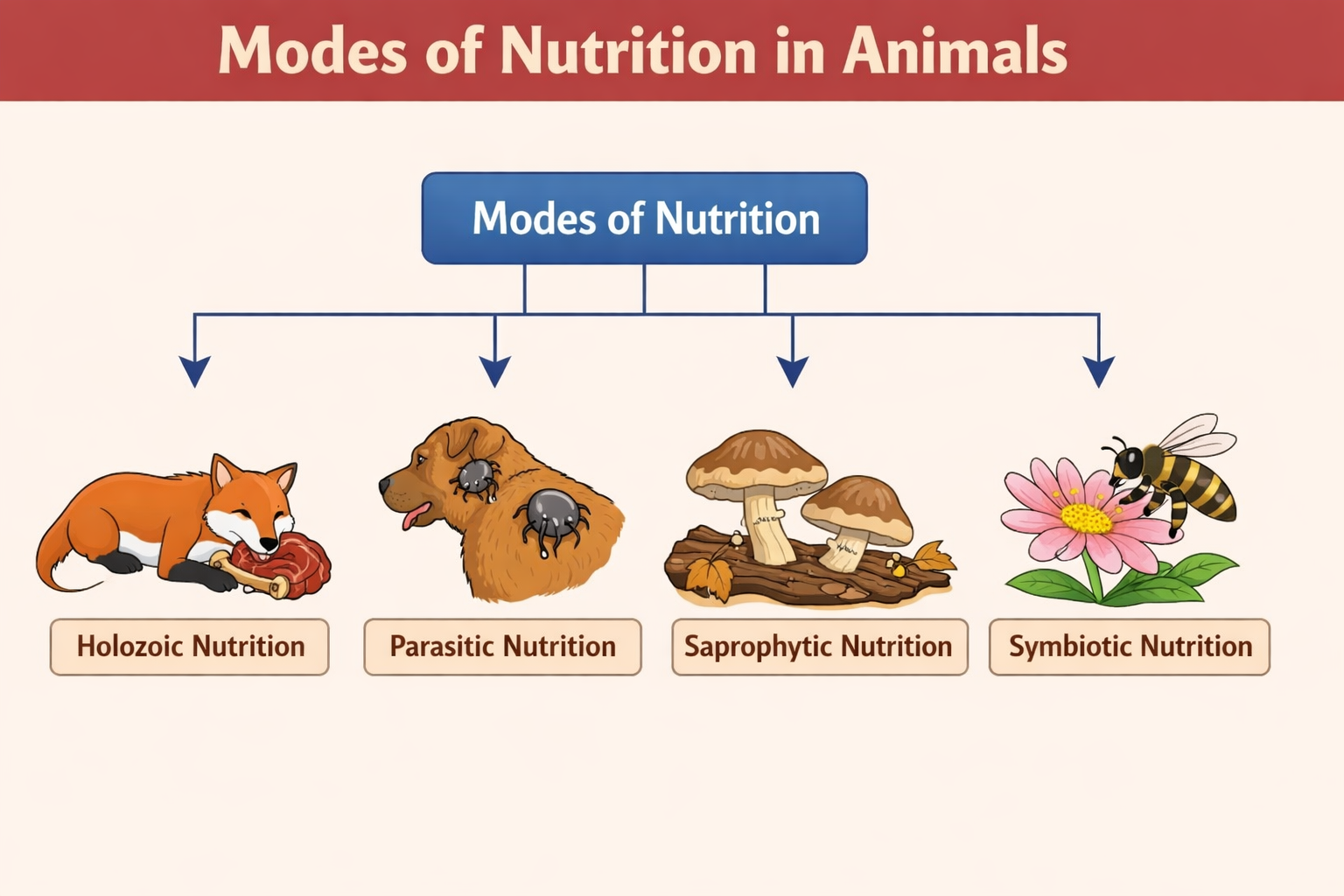
Figure: Major modes of nutrition in animals.
Each mode of nutrition represents a different strategy through which organisms obtain nutrients necessary for survival.
Did You Know?
Many animals have evolved specialized feeding strategies that allow them to survive in very different environments, from deep oceans to dry deserts.
Parasitic Mode of Nutrition
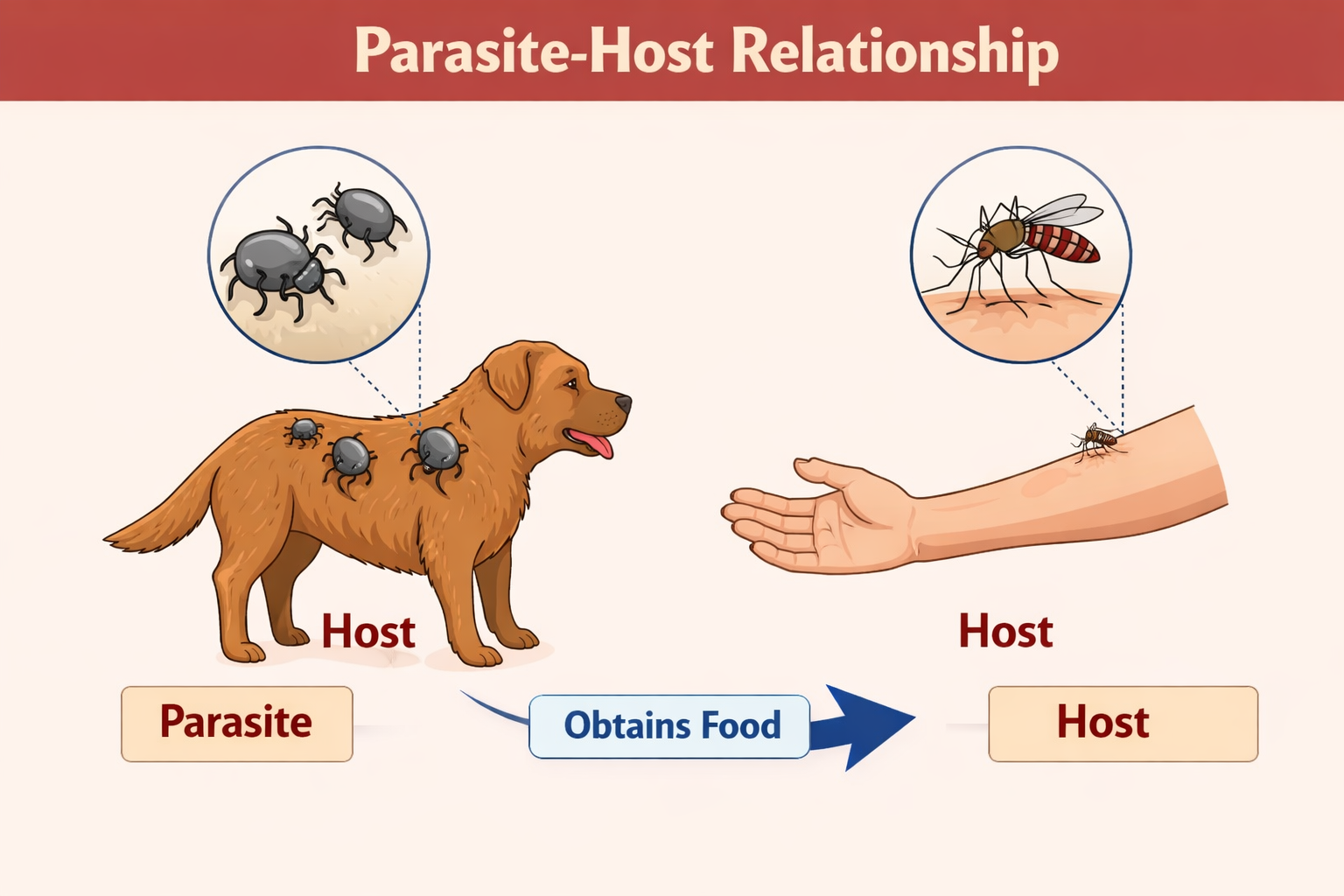
Figure: Parasite–host interaction showing how a parasite obtains nutrients from a host organism.
Parasitic nutrition is a type of nutrition where one organism obtains food from another living organism without providing any benefit in return.
In this relationship:
The organism that obtains food is called the parasite.
The organism that provides food and shelter is called the host.
The parasite benefits from this relationship while the host is usually harmed, weakened or infected with disease.
Characteristics of Parasites
Parasites generally show several distinctive features:
- They depend partially or completely on the host for nutrients.
- They may live inside the host’s body or on the surface of the host.
- Many parasites possess special adaptations for attaching to the host.
- Parasites often cause diseases, weakness or irritation in the host.
- Some parasites absorb nutrients directly from the host’s tissues or bloodstream.
Types of Parasites
Parasites can be classified into two major groups based on where they live in relation to the host.
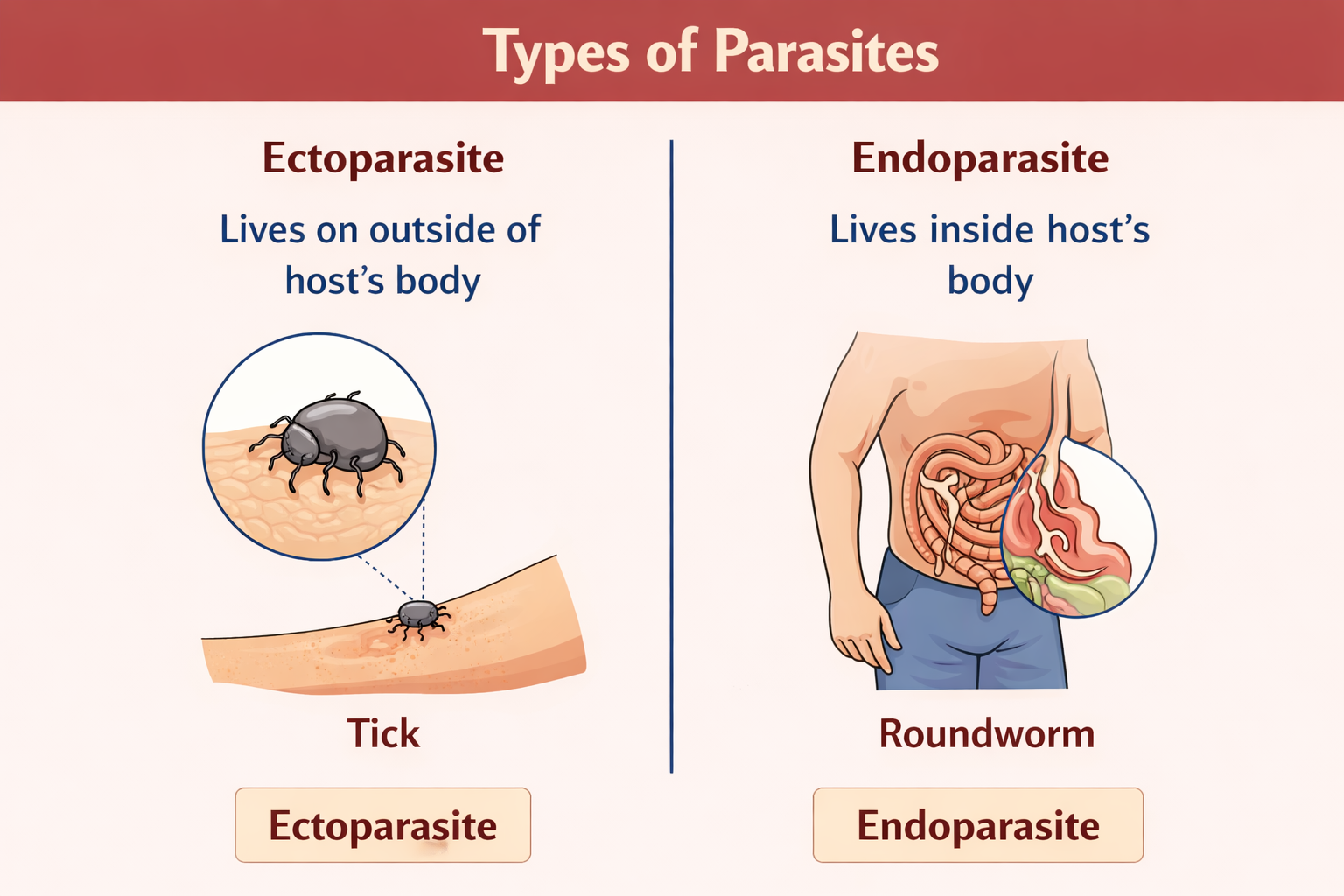
Figure: Comparison between ectoparasites and endoparasites.
1. Ectoparasites (External Parasites)
Ectoparasites live on the external surface of the host’s body.
Examples include: Ticks, Lice, Fleas and Jiggers
Effects on the host:
- Cause irritation and itching
- Suck blood from the host
- May transmit diseases
- Weaken the host over time
2. Endoparasites (Internal Parasites)
Endoparasites live inside the body of the host, often in organs such as the intestines, liver or blood.
Examples include: Roundworms, Tapeworms, Hookworms and Liver flukes
Effects on the host:
- Compete with the host for nutrients
- Cause diseases and infections
- Damage body tissues and organs
- May interfere with digestion and absorption of food
Did You Know?
Some parasites such as tapeworms have no digestive system. They absorb nutrients directly through their body surface from the host’s intestine.
Saprophytic Mode of Nutrition
Saprophytic nutrition is a type of nutrition in which organisms obtain nutrients from dead and decaying organic matter.
Organisms that feed in this way are known as saprophytes.
These organisms play a very important role in ecosystems because they help in the decomposition of organic materials.
How Saprophytes Obtain Food
- They release digestive enzymes onto dead organic matter.
- These enzymes break down complex organic substances into simple soluble substances.
- The simpler nutrients are then absorbed directly into the organism’s body.
- This process is known as external digestion because digestion occurs outside the body of the organism.
Importance of Saprophytes
Saprophytes are extremely important in maintaining ecological balance.
- Break down dead plants and animals
- Recycle nutrients back into the soil
- Increase soil fertility
- Help in the formation of humus
- Prevent accumulation of dead organic matter
Common examples include: Mushrooms, Bread mould, Bacteria and Fungi
Symbiotic Mode of Nutrition
Symbiosis refers to a close association between two different organisms living together, where at least one organism benefits from the relationship.
The organisms involved in symbiosis depend on each other in different ways.
Types of Symbiosis
1. Mutualism
Mutualism is a relationship in which both organisms benefit from living together.
Example:
Bees and flowering plants
Bees obtain nectar and pollen as food.
Flowers benefit because bees transfer pollen between flowers during pollination.
Other examples include:
- Lichens (algae and fungi living together)
- Bacteria in the intestines of animals.
2. Commensalism
Commensalism is a relationship in which one organism benefits while the other organism is neither helped nor harmed.
Example:
Birds sitting on cattle feeding on insects around them.
The bird obtains food while the cattle is unaffected.
Did You Know?
Lichens are actually two organisms living together — a fungus and an alga. The fungus provides protection and moisture while the alga produces food through photosynthesis.
Holozoic Mode of Nutrition
Holozoic nutrition is the mode of nutrition in which animals ingest complex solid food which is then broken down inside the body into simpler soluble substances.
This is the most common mode of nutrition in animals, especially in higher animals such as mammals.
Holozoic nutrition involves a series of processes that occur in the digestive system.
Steps in Holozoic Nutrition
- i. Ingestion – intake of food into the body
- ii. Digestion – breakdown of food into simple substances
- iii. Absorption – movement of nutrients into the bloodstream
- iv. Assimilation – use of nutrients by body cells
- v. Egestion – removal of undigested food materials
Classification of Animals Based on Food They Eat
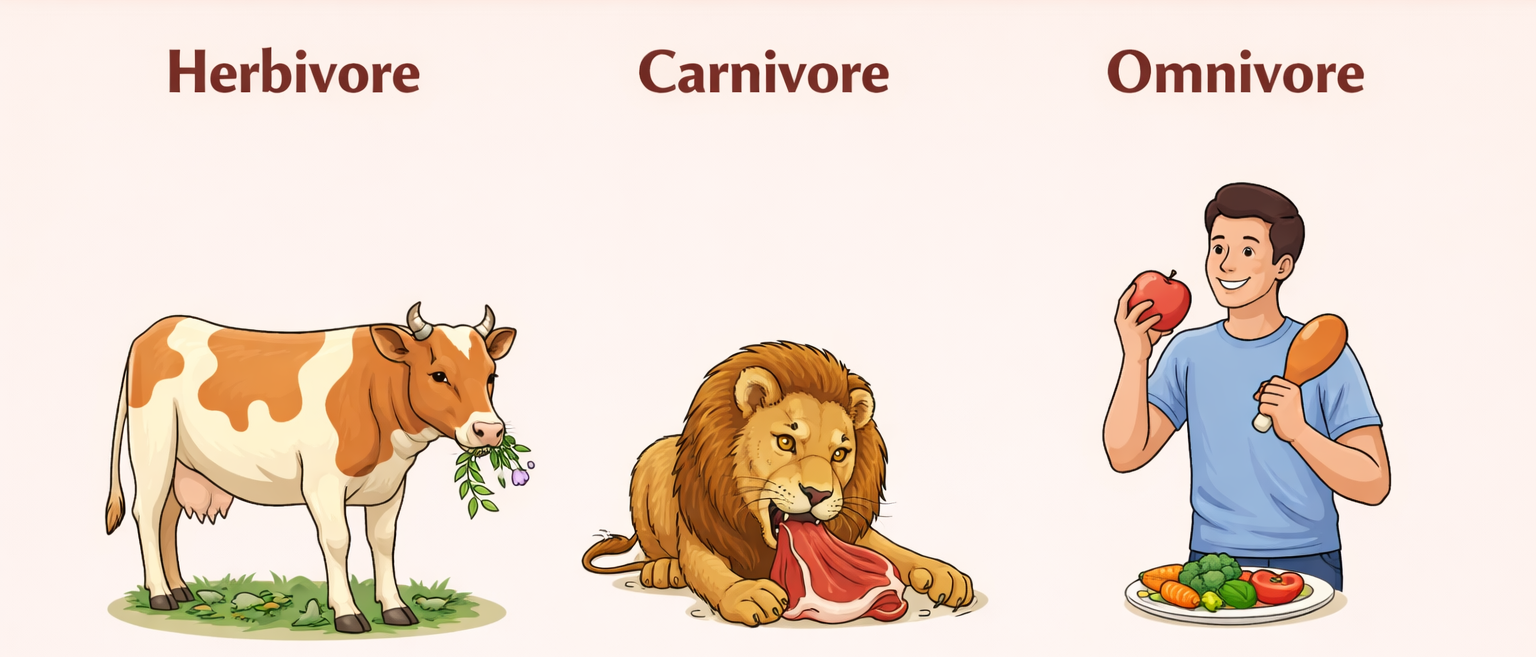
Figure: Classification of animals based on dietary habits (herbivores, carnivores and omnivores).
1. Herbivores
Herbivores are animals that feed mainly or entirely on plants and plant materials.
Examples include: Cows, Goats, Sheep, Rabbits and Antelopes
Characteristics of herbivores:
- Strong grinding teeth
- Well developed premolars and molars
- Digestive systems adapted to digest plant cellulose
2. Carnivores
Carnivores are animals that feed mainly on the flesh of other animals.
Examples include: Lions, Leopards, Dogs, Cheetahs and Hyenas
Characteristics of carnivores:
- Sharp incisors for cutting meat
- Long pointed canines for tearing flesh
- Strong jaws and powerful muscles
3. Omnivores
Omnivores are animals that feed on both plant materials and animal flesh.
Examples include: Human beings, Pigs, Bears, Chickens
Characteristics of omnivores:
- Teeth adapted for cutting, tearing and grinding food
- Flexible feeding habits
Video: Explanation of the different modes of nutrition in animals.
Teeth are specialized structures found in the mouth that help animals capture, cut, tear and grind food before it enters the digestive system.
Mammals possess four main types of teeth.
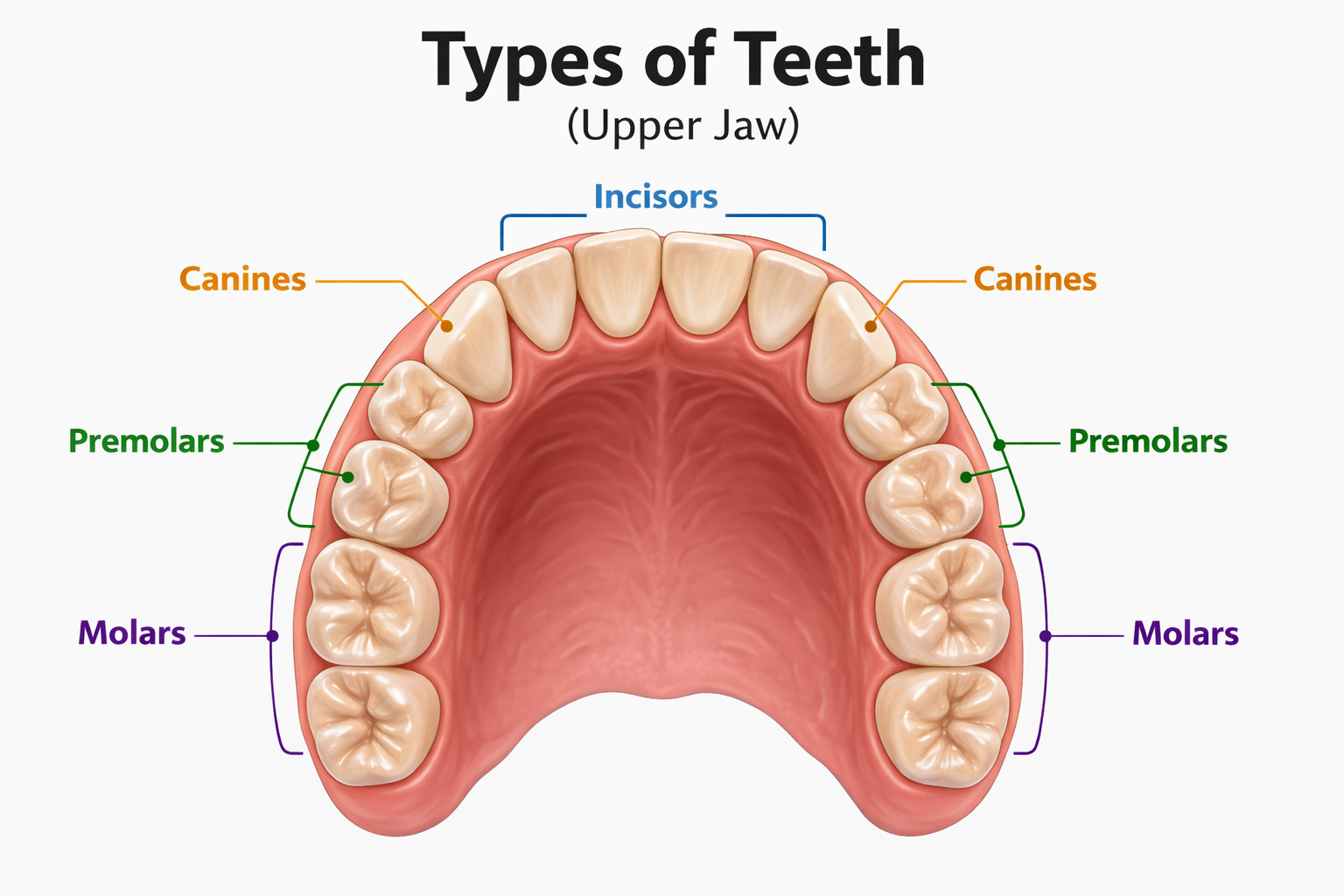
Figure 1: Types of teeth in the human mouth.
Did You Know?
Adult humans normally have 32 permanent teeth, while children usually have 20 temporary (milk) teeth.
1. Incisors
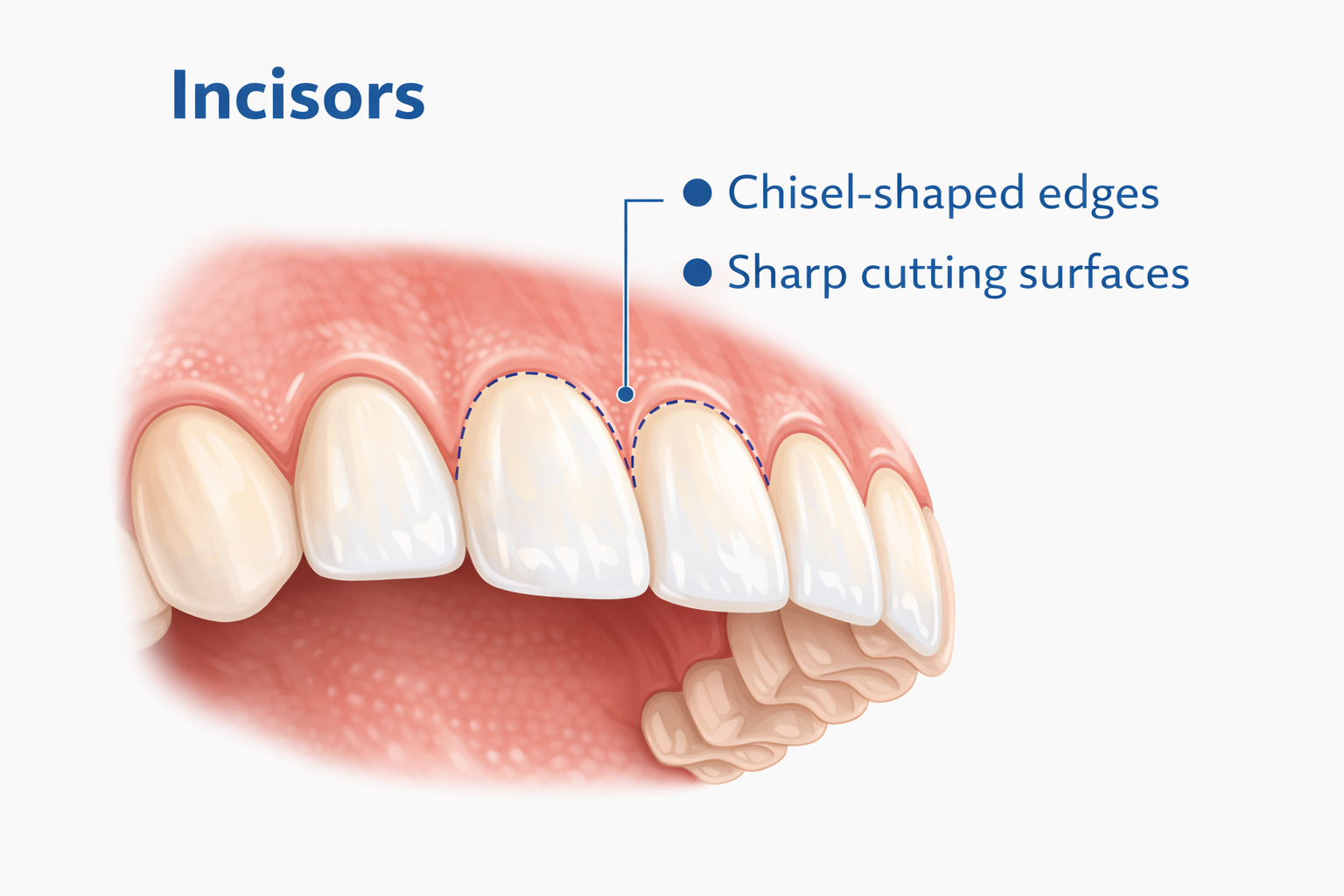
Characteristics:
- Chisel-shaped edges
- Sharp cutting surfaces
- Usually have one root
Functions:
- Cutting food
- Biting food into smaller pieces
2. Canines
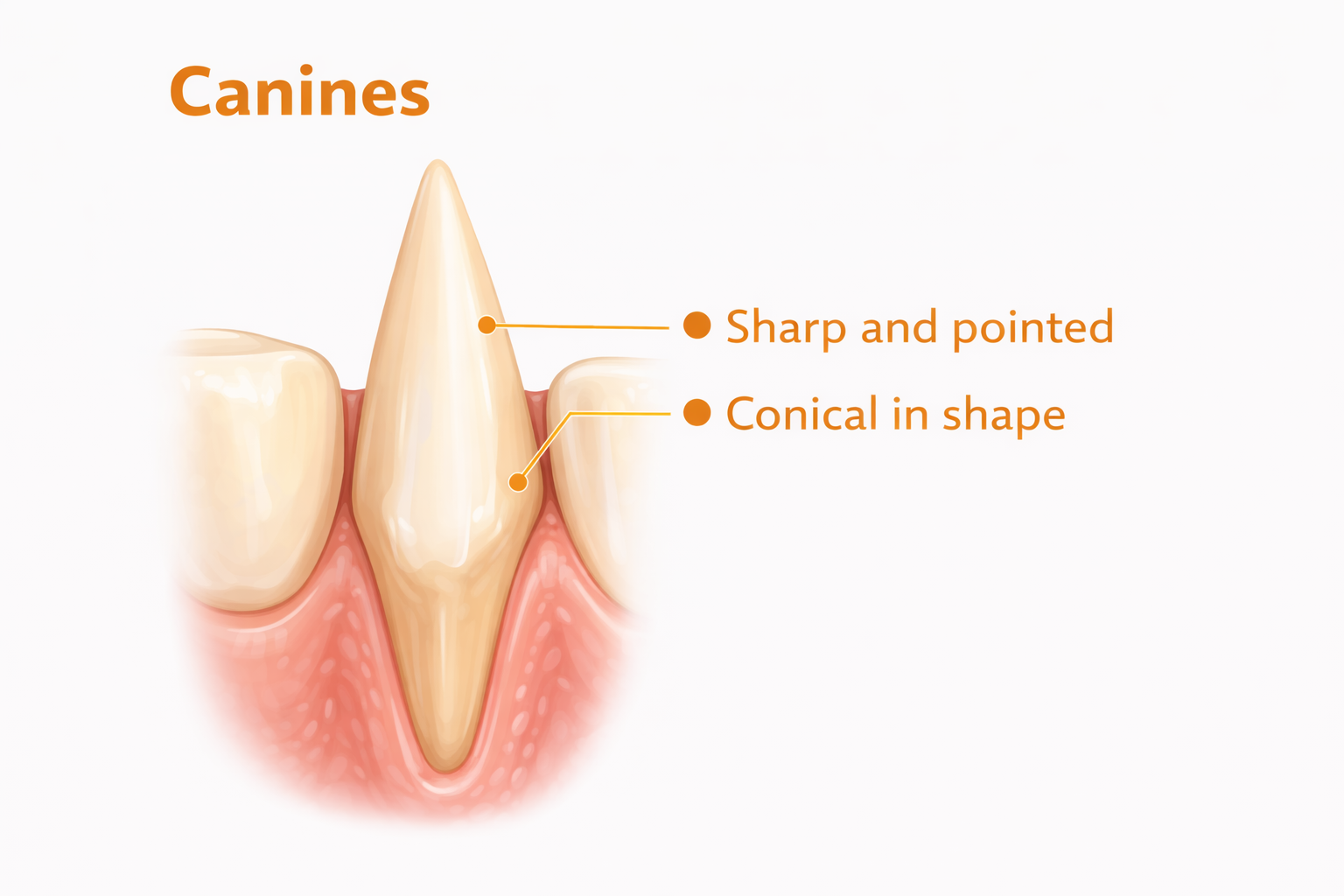
Characteristics:
- Sharp and pointed
- Conical in shape
- Long strong roots
Functions:
- Tearing flesh
- Holding or seizing prey
Did You Know?
Carnivorous animals such as lions and wolves have extremely long and sharp canines that help them capture and tear the flesh of their prey.
3. Premolars
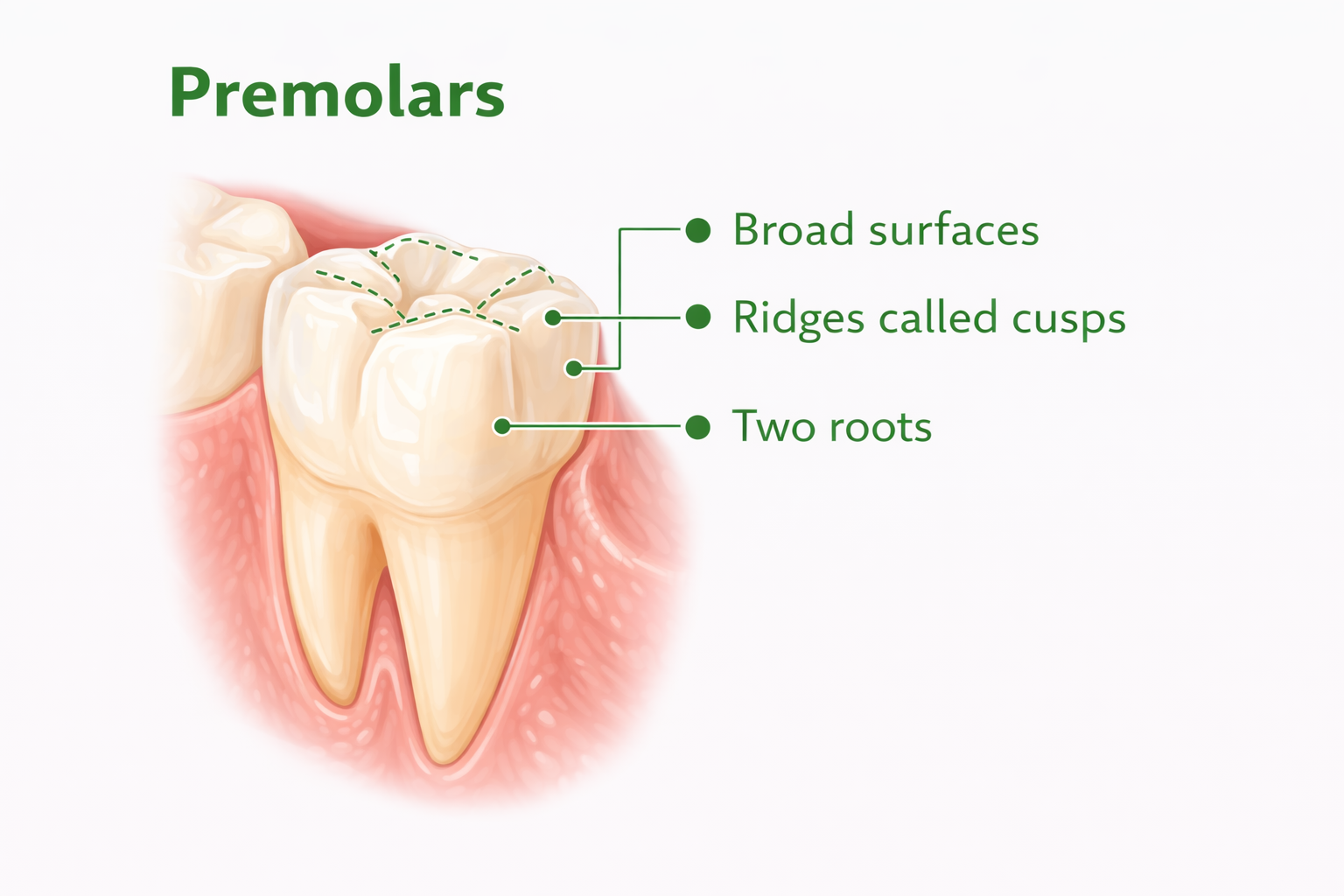
Characteristics:
- Broad surfaces
- Possess ridges called cusps
- Usually have two roots
Functions:
- Crushing food
- Grinding food
4. Molars
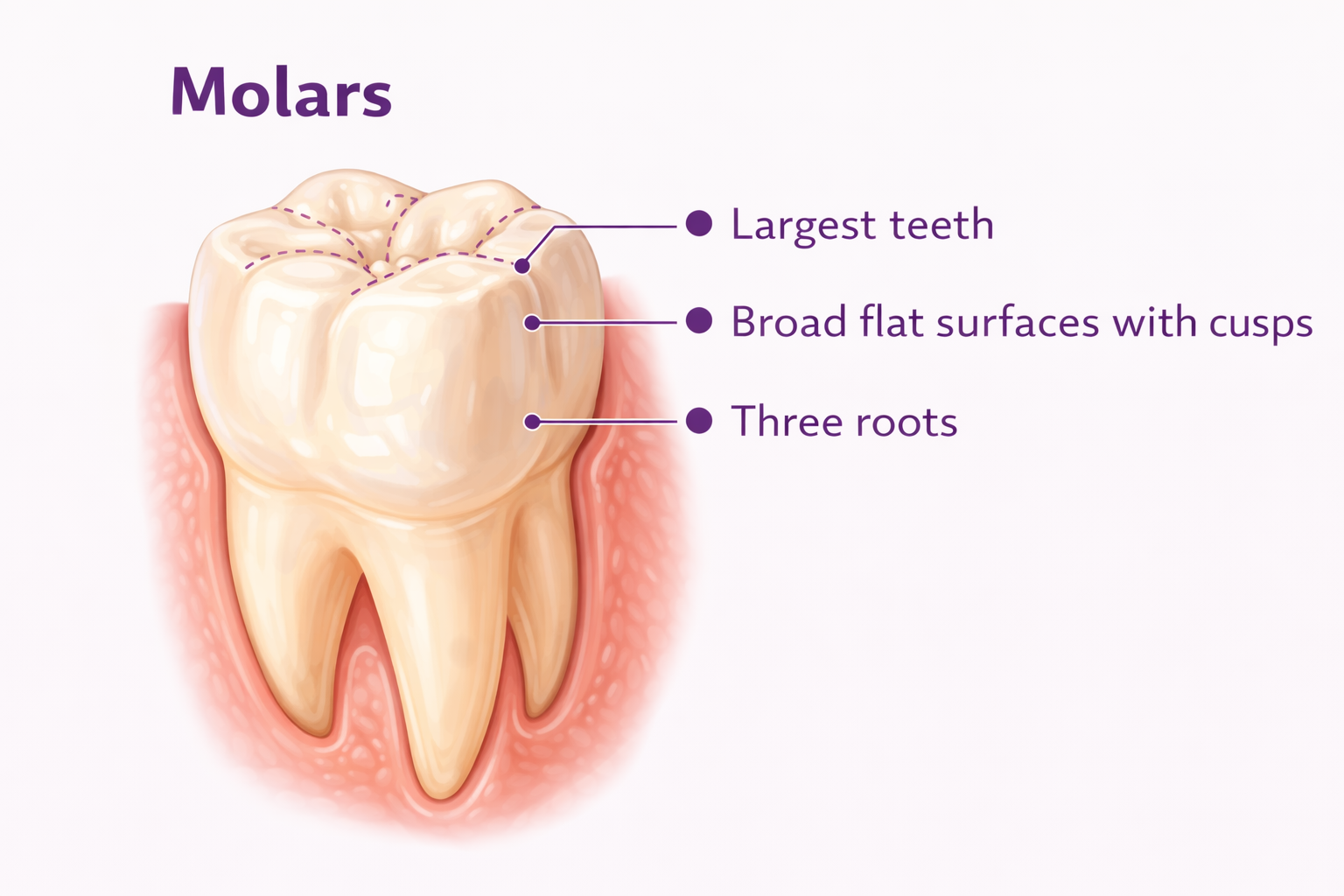
Characteristics:
- Largest teeth
- Broad flat surfaces with cusps
- Usually have three roots
Functions:
- Grinding food thoroughly
- Chewing food before swallowing
Did You Know?
Molars are the strongest teeth in the mouth and are specially adapted to crush and grind food during chewing.
Classifying Animals Based on Their Dentition
Dentition refers to the arrangement, type and number of teeth present in the jaws of an animal.
Dentition varies depending on the animal’s feeding habits.
There are two main types of dentition.
1. Homodont Dentition
In homodont dentition:
- All teeth are similar in size and shape.
- Teeth perform the same function.
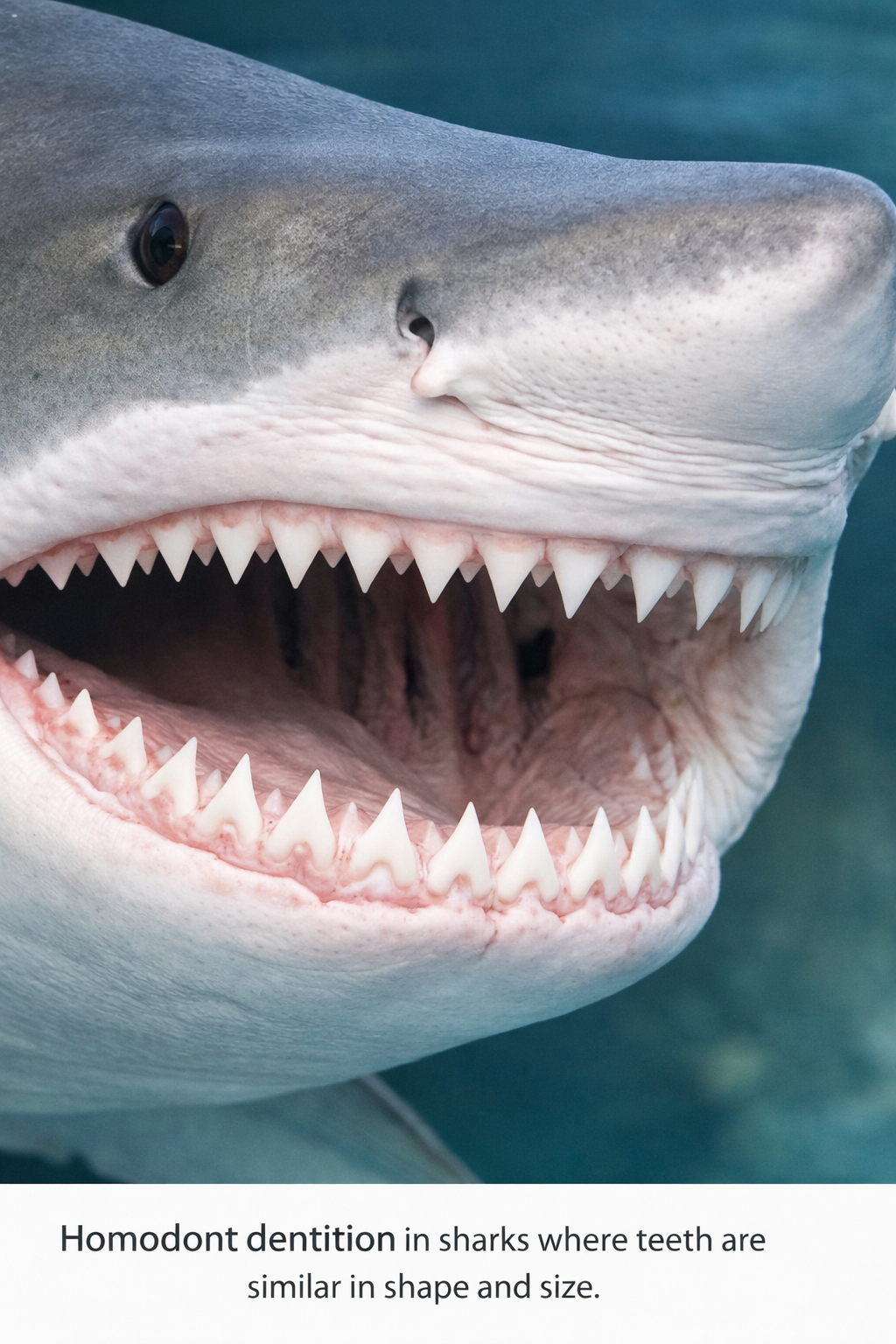
Examples include: Sharks and Crocodiles
These teeth are mainly used for gripping and tearing prey.
2. Heterodont Dentition
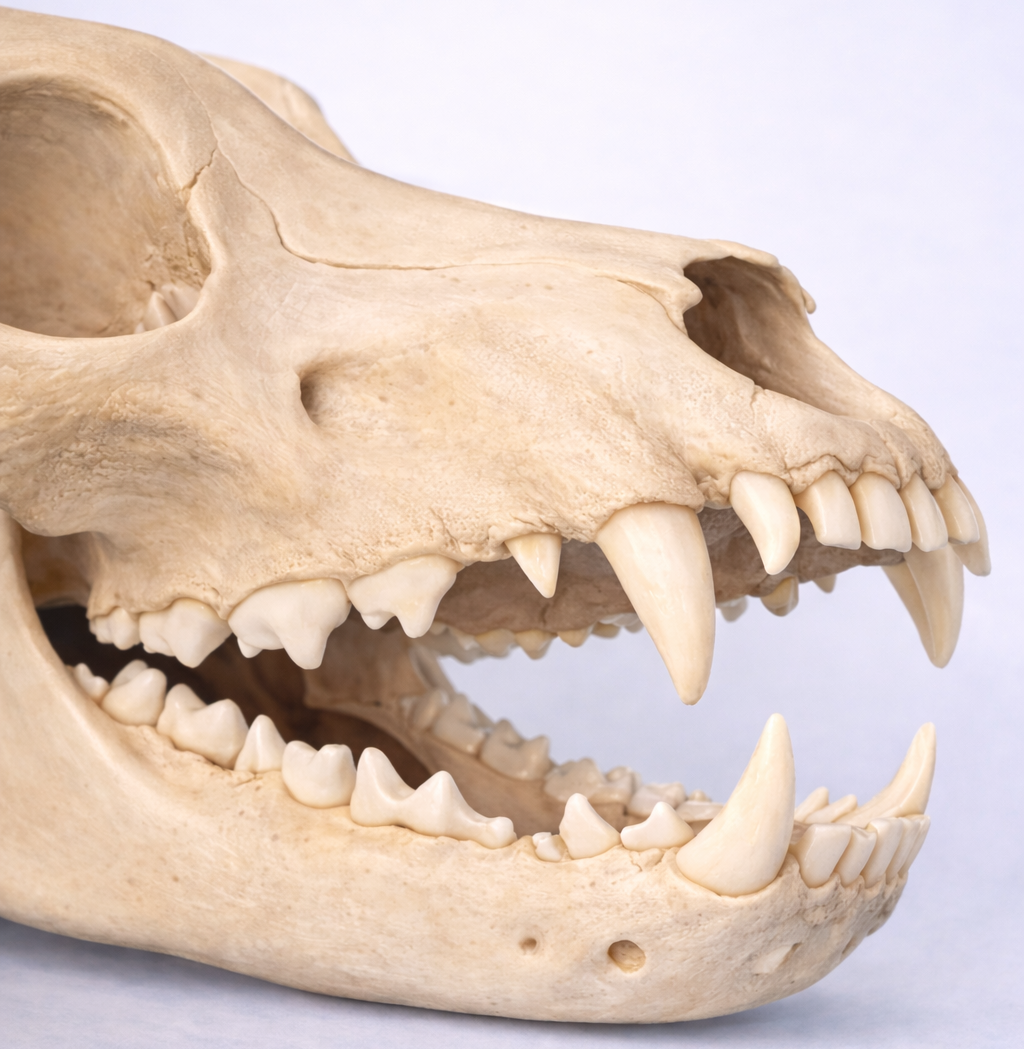
In heterodont dentition:
- Teeth are different in shape and size.
- Each type of tooth performs a specific function.
Examples include: Humans, Dogs, Sheep, Goats and Rabbits
Did You Know?
Sharks have homodont dentition, meaning most of their teeth look alike and are suited for gripping prey rather than chewing it.
Dentition in Different Feeding Groups
Different animals have teeth that are adapted to their feeding habits.
Adaptations of Herbivores
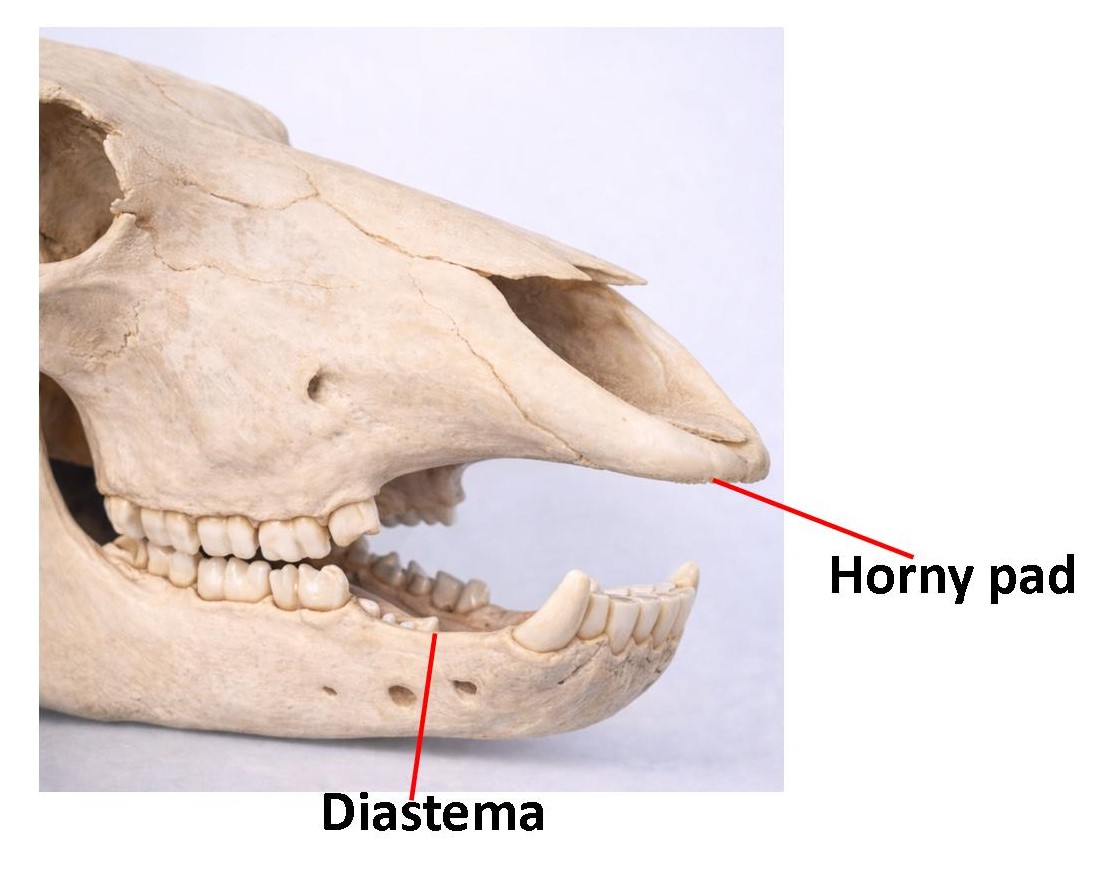
- Lack upper incisors in some species (e.g. cows)
- Possess a horny pad instead
- Have a wide gap called diastema
- Premolars and molars are large and flat for grinding vegetation
Did You Know?
In animals such as cows, the horny pad helps them grasp grass even though they do not have upper incisors.
Adaptations of Carnivores
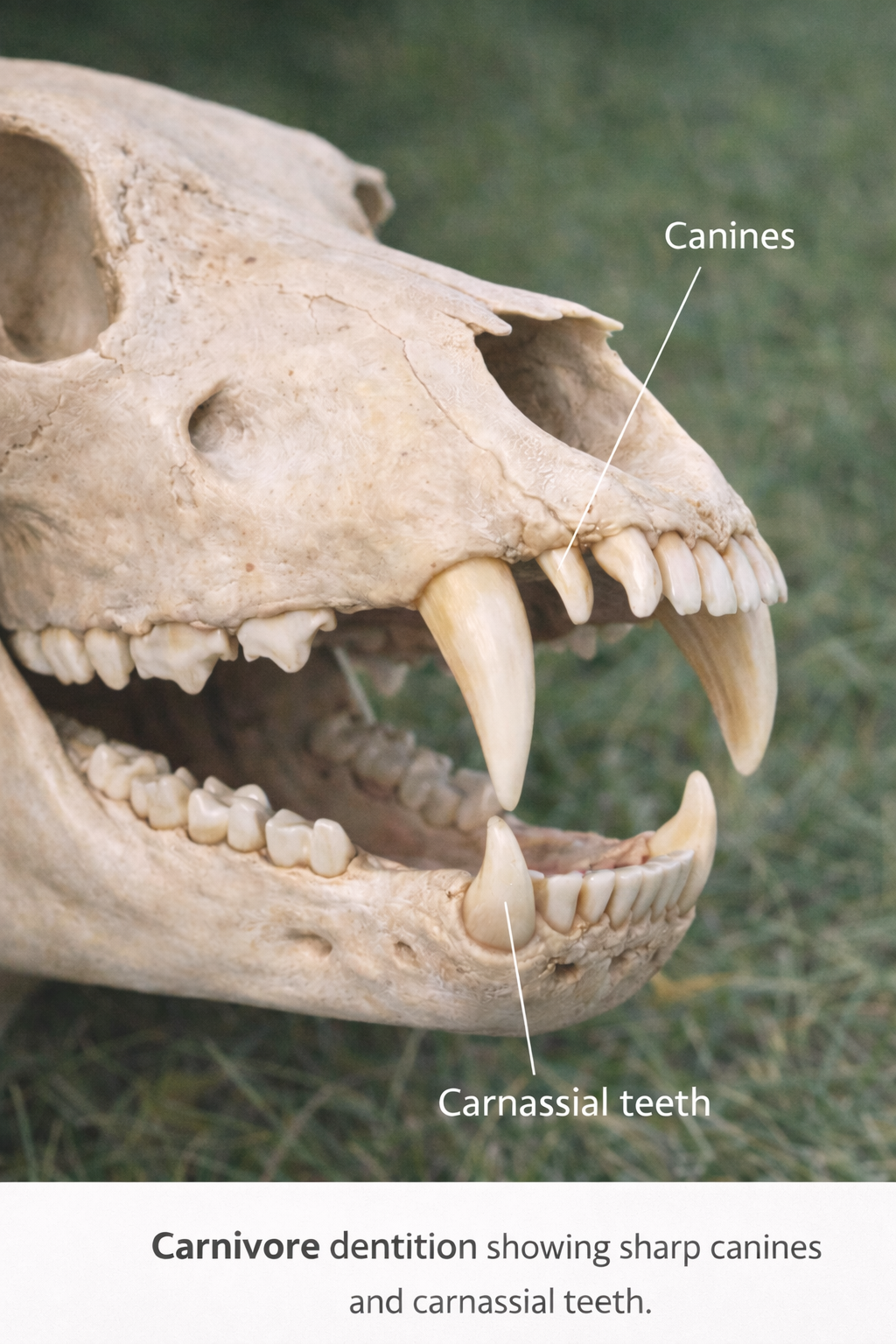
- Sharp incisors for cutting flesh
- Long pointed canines for tearing meat
- Special teeth called carnassial teeth for slicing flesh and crushing bones
Adaptations of Omnivores
- Small incisors for cutting food
- Moderately developed canines
- Premolars and molars used for grinding both plant and animal food
Did You Know?
Omnivores have mixed dentition because they eat both plant and animal matter, so their teeth are adapted for more than one type of food.
The Process of Digestion in Human Beings
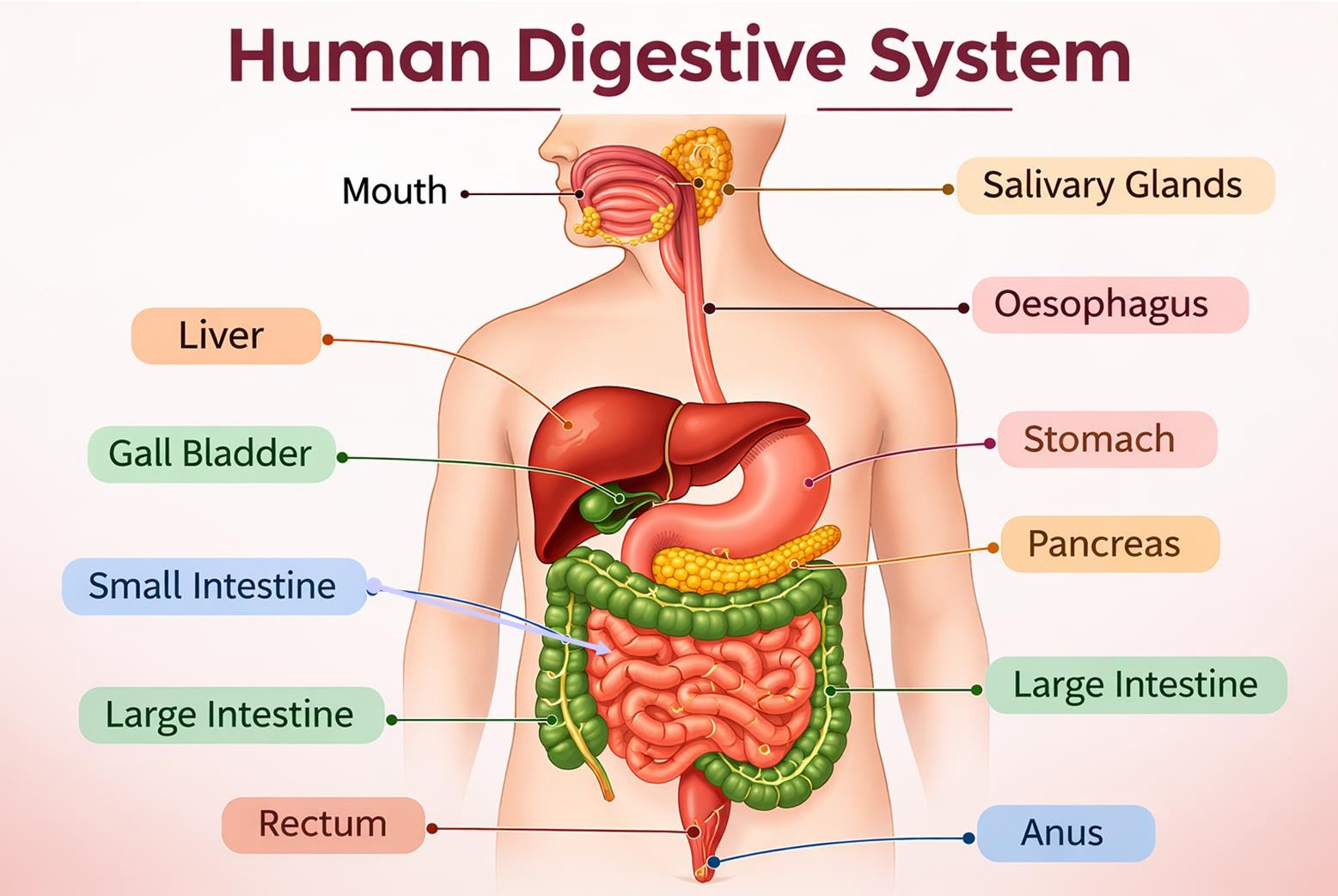
The digestive system is responsible for breaking down food into simpler substances that can be absorbed into the body and used for energy and growth.
The digestive system forms a long tube called the alimentary canal, which extends from the mouth to the anus.
Did You Know?
The alimentary canal forms one long continuous tube from the mouth to the anus.
Did You Know?
Most absorption of digested food takes place in the ileum because of the many villi on its inner surface.
Did You Know?
Peristalsis helps push food through the oesophagus using rhythmic muscle contractions.
Major Parts of the Digestive System
Main parts include:
- Mouth
- Oesophagus
- Stomach
- Small intestine
- Large intestine
- Rectum
- Anus
Accessory organs include:
- Liver
- Pancreas
- Salivary glands
These organs assist in producing digestive juices that help in the digestion of food.
Processes of Nutrition in Humans
1. Ingestion
Ingestion is the process of taking food into the mouth.
- Food enters the digestive system
- Digestion begins immediately in the mouth
During Ingestion:
2. Digestion
Digestion is the process of breaking down complex food substances into simpler soluble substances that can be absorbed into the bloodstream.
-
Digestion occurs in two forms:
- Mechanical digestion – chewing and mixing of food
- Chemical digestion – breakdown of food by enzymes
3. Absorption
Absorption is the movement of digested food substances from the intestine into the bloodstream.
Most absorption takes place in the ileum of the small intestine.
4. Assimilation
Assimilation is the process by which absorbed nutrients are used by body cells.
-
For example:
- Glucose is used for energy production
- Amino acids are used for growth and tissue repair
- Fats are used for energy storage
5. Egestion
Egestion is the removal of undigested and indigestible food materials from the body through the anus.
Digestion in the Mouth
Digestion begins in the mouth where food undergoes both mechanical and chemical digestion.
Processes occurring in the mouth include:
- Mastication (chewing) by teeth
- Mixing of food with saliva
- Formation of a soft food mass called a bolus
Saliva contains:
- Water
- Mucus
- Salivary amylase (ptyalin)
Functions of saliva:
- Moistens food
- Lubricates food for easy swallowing
- Begins digestion of starch
- Salivary amylase breaks down starch into maltose.
Swallowing and Movement of Food
After chewing, the tongue pushes the food bolus to the back of the mouth for swallowing.
Food then passes into the oesophagus.
Movement of food through the oesophagus occurs by peristalsis, which involves rhythmic contractions of muscles that push food towards the stomach.
Digestion in the Stomach
The stomach is a muscular organ where food is mixed and churned with gastric juice.
Gastric juice contains:
- Hydrochloric acid
- Pepsin
- Rennin
Functions:
Hydrochloric acid:
- Kills harmful bacteria in food
- Provides acidic conditions for enzyme activity
Pepsin: Breaks proteins into smaller peptides
Rennin: Helps in digestion of milk proteins (especially in infants)
Food in the stomach becomes a semi-liquid substance called chyme.
Digestion in the Duodenum
The duodenum is the first part of the small intestine.
Here food mixes with:
- Bile from the liver
- Pancreatic juice from the pancreas
Functions of bile:
- Breaks fats into small droplets (emulsification)
- Creates an alkaline medium for enzyme activity
Pancreatic enzymes include:
- Trypsin → breaks proteins into peptides
- Pancreatic lipase → breaks fats into fatty acids and glycerol
- Pancreatic amylase → breaks starch into maltose
Digestion and Absorption in the Ileum
Digestion is completed in the ileum, which is the last part of the small intestine.
Intestinal enzymes include:
- Peptidase → converts peptides to amino acids
- Lipase → converts fats to fatty acids and glycerol
- Maltase → converts maltose to glucose
- Sucrase → converts sucrose to glucose and fructose
- Lactase → converts lactose to glucose and galactose
Absorption in the Ileum
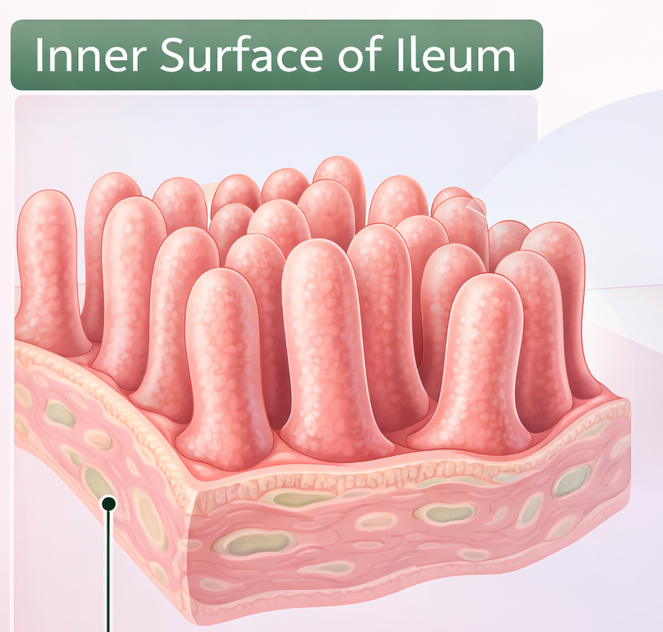
The inner surface of the ileum has finger-like projections called villi.
Functions of villi:
- Increase surface area for absorption
- Transport nutrients into the bloodstream
Absorbed nutrients include:
- Glucose
- Amino acids
- Fatty acids
- Glycerol
Large Intestine and Egestion
In the large intestine (colon):
- Water is absorbed from undigested food
- Mineral salts are absorbed
- Remaining waste forms faeces
Faeces are stored temporarily in the rectum and are later expelled through the anus.
The process of removing faeces from the body is called egestion.
Summary
Nutrition in Animals
- Animals are heterotrophs (cannot make own food).
- Depend on plants or other animals.
- Food provides energy, growth and repair.
- Supports body processes.
Feeding Types
- Herbivores eat plants.
- Carnivores eat animals.
- Omnivores eat both plants and animals.
- Feeding depends on structure and behaviour.
Processes of Nutrition
- Ingestion – taking in food.
- Digestion – breaking food down.
- Absorption – nutrients enter blood.
- Assimilation – use by body cells.
- Egestion – removal of waste.
Modes of Nutrition
- Holozoic nutrition
- Parasitic nutrition
- Saprophytic nutrition
- Symbiotic nutrition
Parasitic Nutrition
- Parasite feeds on a host.
- Host is harmed.
- May cause diseases.
- Parasites depend on host for survival.
Types of Parasites
- Ectoparasites live on body surface.
- Endoparasites live inside the body.
- Cause weakness and infections.
- Examples include lice and worms.
Saprophytic Nutrition
- Feed on dead organic matter.
- Digest food externally using enzymes.
- Absorb simple nutrients.
- Help in decomposition.
Importance of Saprophytes
- Recycle nutrients into soil.
- Improve soil fertility.
- Form humus.
- Prevent waste accumulation.
Symbiotic Nutrition
- Close relationship between organisms.
- At least one benefits.
- Includes mutualism and commensalism.
- Important in ecosystems.
Holozoic Nutrition
- Common in most animals.
- Food ingested and digested internally.
- Involves five stages of nutrition.
- Occurs in digestive system.
Types of Teeth
- Incisors – cutting food.
- Canines – tearing flesh.
- Premolars – crushing food.
- Molars – grinding food.
Dentition Types
- Homodont – similar teeth.
- Heterodont – different teeth types.
- Depends on feeding habits.
- Common in different animals.
Feeding Adaptations
- Herbivores have grinding teeth.
- Carnivores have sharp tearing teeth.
- Omnivores have mixed teeth.
- Adapted to diet.
Digestive System
- Breaks down food into simple forms.
- Includes mouth, stomach and intestines.
- Forms alimentary canal.
- Supported by liver and pancreas.
Digestion in Mouth
- Food is chewed and mixed with saliva.
- Saliva contains amylase enzyme.
- Starch is broken into maltose.
- Forms bolus for swallowing.
Digestion in Stomach
- Food mixed with gastric juice.
- HCl kills bacteria.
- Pepsin breaks proteins.
- Forms chyme.
Digestion in Small Intestine
- Bile emulsifies fats.
- Pancreatic enzymes digest food.
- Digestion completed in ileum.
- Produces simple nutrients.
Absorption & Assimilation
- Occurs in ileum using villi.
- Nutrients enter bloodstream.
- Used for energy and growth.
- Stored or utilized by cells.
Egestion
- Removal of undigested food.
- Occurs through anus.
- Water absorbed in large intestine.
- Waste forms faeces.
Assessment
Nutrition in Animals Assessment
Answer all 15 questions. Your results will be marked automatically.
15 Questions
Certificate of Achievement
This certifies that
has successfully completed the assessment on
Nutrition in Animals
Score: