Interdependence of Life, Food Chains and Food Webs
Learn how living and non-living components of the environment interact,
how food chains and food webs are formed, and why interdependence is
essential for maintaining balance in ecosystems.
Introduction
Interdependence is the relationship where living organisms depend on each other for survival.
In any natural environment, no organism lives completely on its own. Instead, living things
interact with other organisms and with the non-living components around them in order to
obtain what they need to survive.
These interactions are essential for the functioning of ecosystems. Organisms depend on one
another for many important processes such as obtaining food, reproduction, protection, and
maintaining environmental balance.
For example, animals depend on plants for food and oxygen, while plants depend on animals
and insects for pollination and seed dispersal. In addition, organisms depend on non-living
factors such as water, sunlight, air, and soil nutrients.
Examples of things organisms depend on include:
- Food
- Shelter
- Protection
- Pollination
- Seed dispersal
Because of these interactions, living and non-living components form a network of
relationships that helps maintain balance and stability within ecosystems.
2.4.1 Biotic and Abiotic Factors of the Environment
The environment consists of everything that surrounds living organisms and influences their survival.
These components can be grouped into two main categories: biotic components and abiotic components.
1. Biotic Components
Biotic components are the living parts of the environment. These include all organisms that grow, reproduce, and interact with other living things.
Examples:
- Plants
- Animals
- Humans
- Microorganisms such as bacteria and fungi
💡 Did You Know?
Earthworms are important biotic components in soil ecosystems.
As they move through soil, they mix organic matter and improve soil fertility, helping plants grow better.
Biotic components interact with each other through feeding relationships, competition for resources, and cooperative relationships such as pollination and symbiosis.
Examples of interactions:
- Herbivores feed on plants
- Carnivores feed on herbivores
- Decomposers break down dead organisms and recycle nutrients
1. Abiotic Components
Abiotic components are the non-living parts of the environment that influence the survival and distribution of living organisms.
Examples include:
- Water
- Temperature
- Wind
- Humidity
- Light
- Atmospheric pressure
- Soil pH
- Salinity
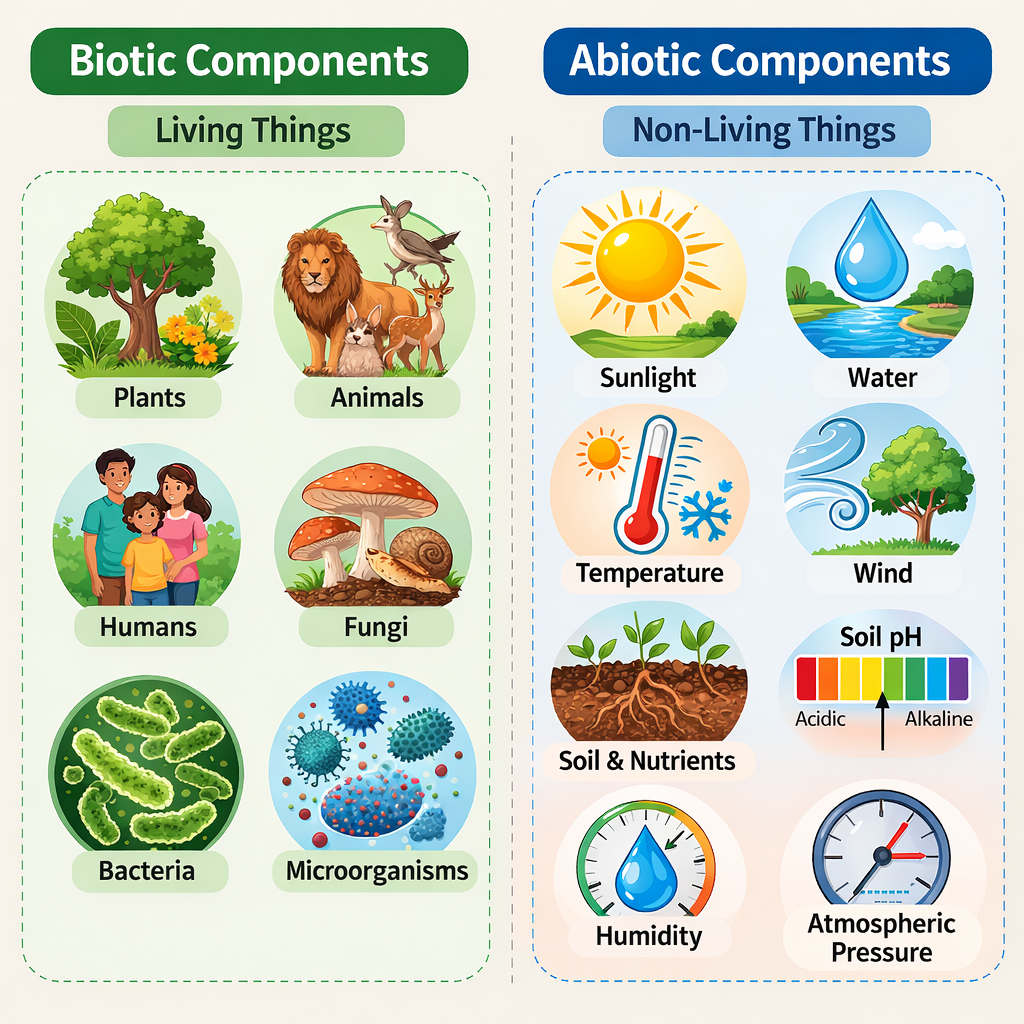
Living organisms depend on abiotic factors for survival and growth. For example, plants require sunlight for photosynthesis, animals require oxygen for respiration, and all organisms require water for metabolic processes.
Interrelationships Between Living Organisms
Living organisms interact with each other as they compete for limited resources necessary for survival.
These resources include:
- Food
- Water
- Space
- Shelter
Main types of interrelationships:
- Predation
- Competition
- Parasitism
- Symbiosis
- Saprophytism
a) Predation
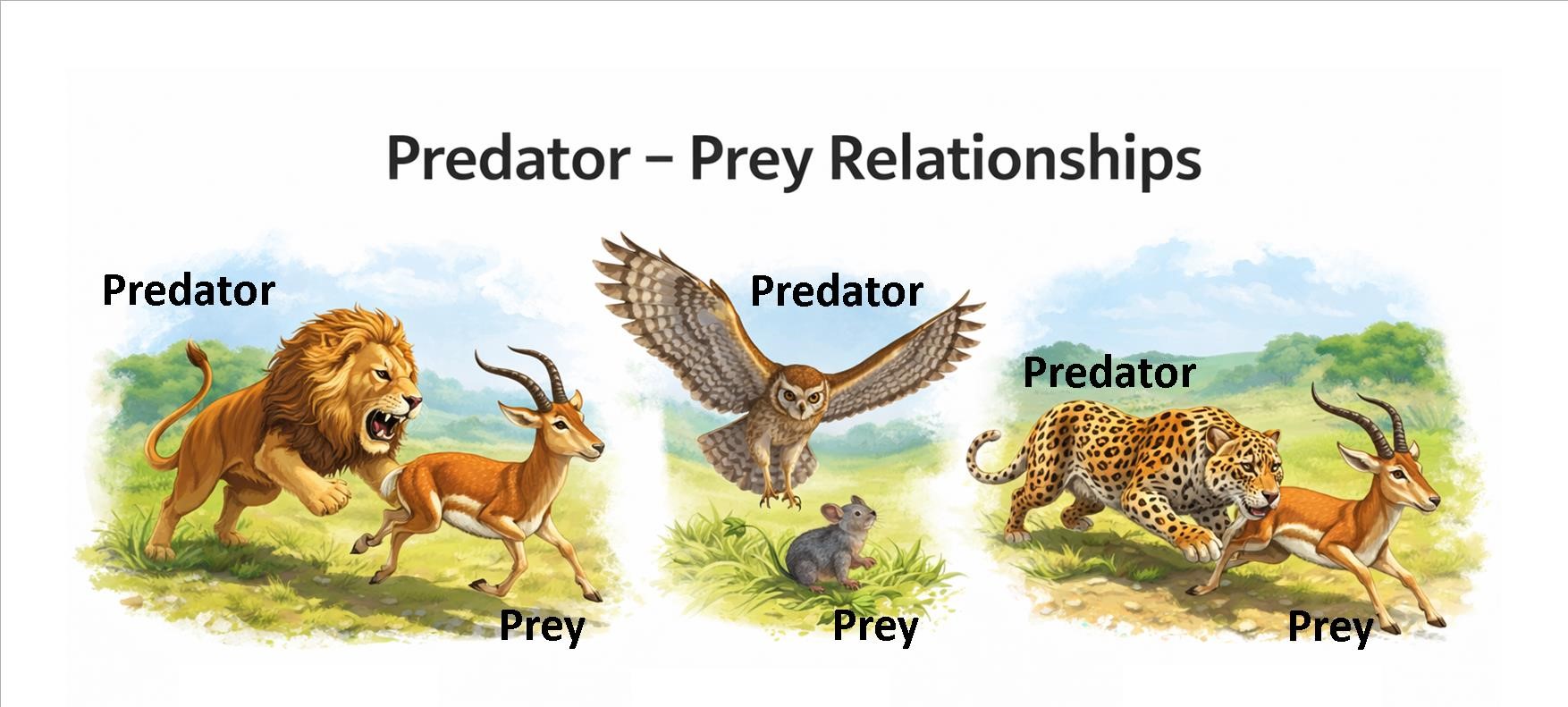
Predation is a relationship where one organism kills another organism for food.
- Predator – the organism that hunts
- Prey – the organism that is eaten
Examples:
- Lion hunting antelope
- Owl catching mice
- Birds feeding on insects
💡 Did You Know?
Some predators hunt using special biological tools. For example,
bats use echolocation to locate insects in the dark, while snakes detect heat from their prey using special heat-sensing organs.
Importance of Predation
- Controls prey population
- Maintains ecological balance
- Provides food for predators
- Removes weak or sick individuals
Adaptations of Predators
- Sharp claws
- Sharp teeth
- Strong jaws
- Good eyesight
- Fast movement
- Venom in some species
Adaptations of Prey
- Camouflage
- High speed
- Protective structures such as shells or horns
- Living in groups
- Highly developed senses
b) Competition
Competition occurs when organisms struggle for the same limited resources in their environment.
Resources include:
- Food
- Water
- Space
- Shelter
- Light
- Nutrients
Types of Competition
1. Intraspecific Competition – competition within the same species.
- Maize plants competing for nutrients
- Dogs fighting for food
- Male animals competing for mates
2. Interspecific Competition – competition between different species.
- Lions and leopards competing for prey
- Different plant species competing for sunlight
- Crops and weeds competing for nutrients
c) Parasitism
Parasitism is a relationship where one organism benefits while the other is harmed.
- Parasite – benefits
- Host – harmed
Types of Parasites
Ectoparasites:
- Fleas
- Ticks
- Lice
Endoparasites:
- Tapeworms
- Roundworms
- Hookworms
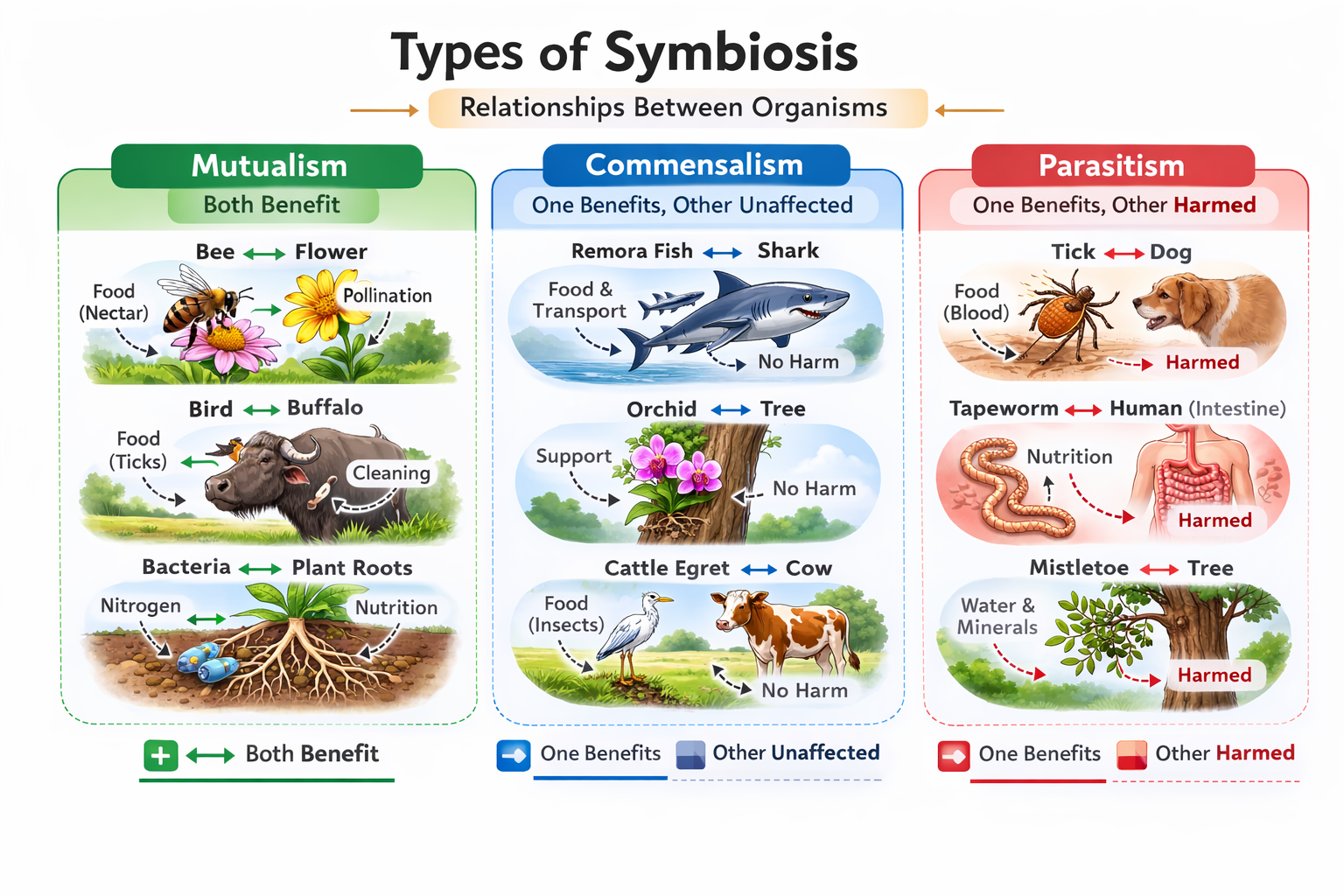
d) Symbiosis
Symbiosis is a close relationship between organisms where at least one organism benefits.
Types:
- Mutualism – both organisms benefit
- Commensalism – one benefits, the other unaffected
e) Saprophytism
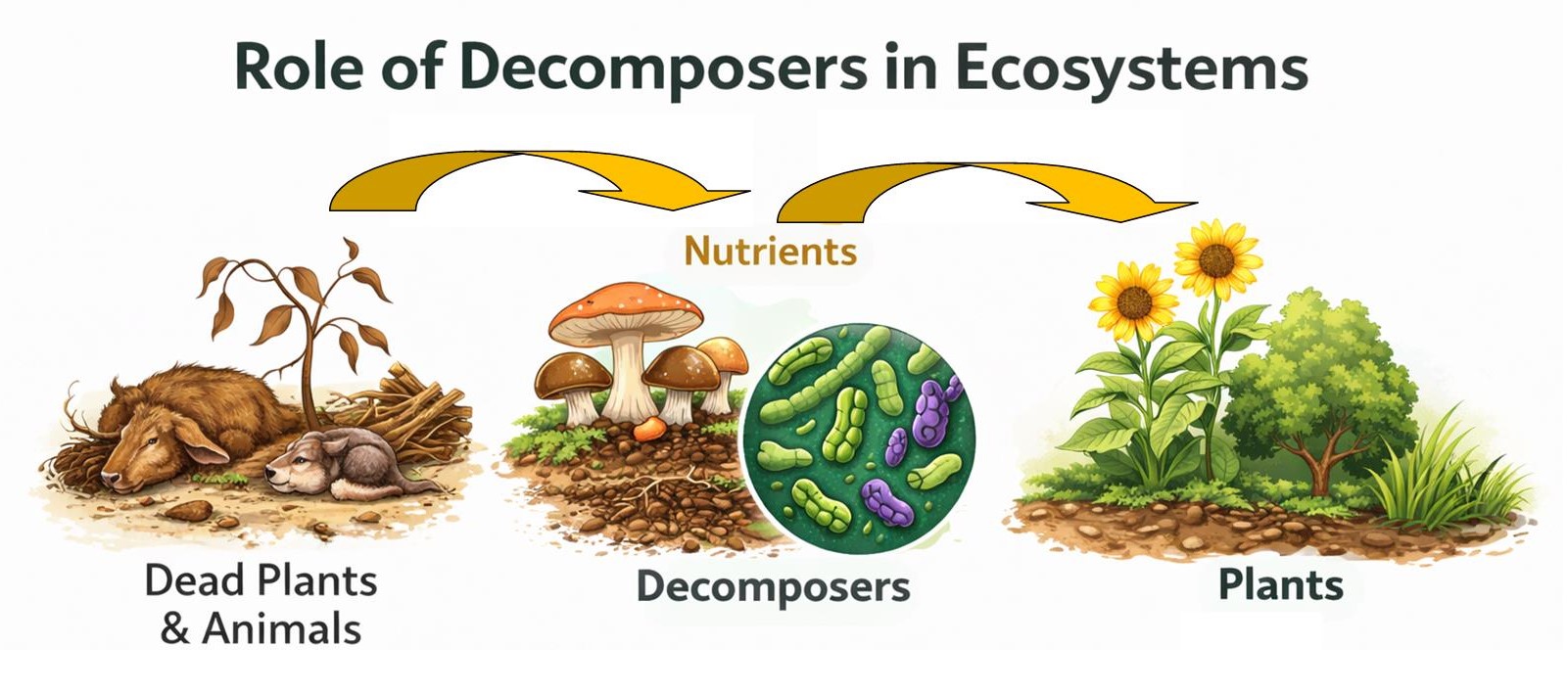
Saprophytism is a feeding relationship where organisms obtain nutrients from dead and decaying matter.
Examples:
- Mushrooms
- Yeast
- Moulds
- Bacteria
These organisms act as decomposers and recycle nutrients back into the environment.
Abiotic Factors Affecting Living Organisms
Abiotic factors influence the survival, growth, reproduction, and distribution of organisms.
Important abiotic factors:
- Water
- Wind
- Light
- Salinity
- Temperature
- Atmospheric pressure
- pH
Effect of Water
- Supports plant growth
- Maintains animal body processes
- Improves crop production
Water shortage may lead to plant death, food scarcity, and reduced animal populations.
Effect of Wind
- Disperses pollen and seeds
- Helps plant reproduction
- May cause soil erosion and crop damage
Effect of Light
- Enables photosynthesis
- Influences plant growth and flowering
- Affects animal behaviour patterns
Effect of Temperature
- Affects metabolism
- Influences reproduction
- Determines distribution of organisms
Effect of pH
- Controls nutrient availability in soil
- Affects plant growth
- Influences aquatic life distribution
Construction of Simple Food Chain and Food Web
.food-section h3{
color:#c23b3b;
border-left:6px solid #ff9e9e;
padding-left:10px;
margin-bottom:12px;
}
.food-box{
background:#fff5f5;
border-left:5px solid #ff9e9e;
padding:16px;
border-radius:10px;
margin:18px 0;
}
.food-box h4{
color:#a83232;
margin-bottom:10px;
}
.level-box{
background:#fffafa;
border-left:4px solid #ffbdbd;
padding:14px;
border-radius:8px;
margin:14px 0;
}
.level-box h5{
color:#b83a3a;
margin-bottom:6px;
}
.food-chain-example{
background:#ffecec;
border-radius:8px;
padding:10px;
margin-top:10px;
font-weight:600;
}
ul{
padding-left:20px;
margin-top:8px;
}
li{
margin-bottom:6px;
}
2.4.2 Food Chains and Food Webs
Food Chains
A food chain is a linear sequence that shows how energy flows from one organism to another through feeding relationships.
Energy usually begins with the sun, passes to plants, and then moves through animals that feed on those plants or on other animals.
Arrows in a food chain indicate the direction of energy flow from one organism to another.
Levels in a Food Chain
1. Producers
Producers are organisms that manufacture their own food using sunlight through photosynthesis.
Examples:
- Grass
- Maize plants
- Algae
These organisms form the first level of the food chain.
2. Primary Consumers
Primary consumers are animals that feed directly on plants. They are also known as herbivores.
Examples:
- Goat
- Cow
- Rabbit
- Grasshopper
3. Secondary Consumers
Secondary consumers feed on primary consumers.
Examples:
- Frog
- Snake
- Wild dog
These animals are usually carnivores or omnivores.
4. Tertiary Consumers
Tertiary consumers are top predators that feed on secondary consumers.
Examples:
- Hawk
- Lion
- Eagle
These organisms are often found at the top of the food chain.
Examples of Food Chains
Grass → Goat → Human
Grass → Grasshopper → Frog → Snake
Seaweed → Fish → Human
These food chains show how energy moves from producers to consumers.
💡 Did You Know?
Only about 10% of energy in a food chain is passed from one level to the next.
Most of the energy is lost as heat or used by organisms for movement and life processes.
Food Webs
A food web is a complex network of interconnected food chains within an ecosystem.
Unlike a simple food chain, a food web shows multiple feeding relationships between organisms.
Most organisms feed on more than one type of food. Therefore, food webs provide a more realistic representation of how energy flows in ecosystems.
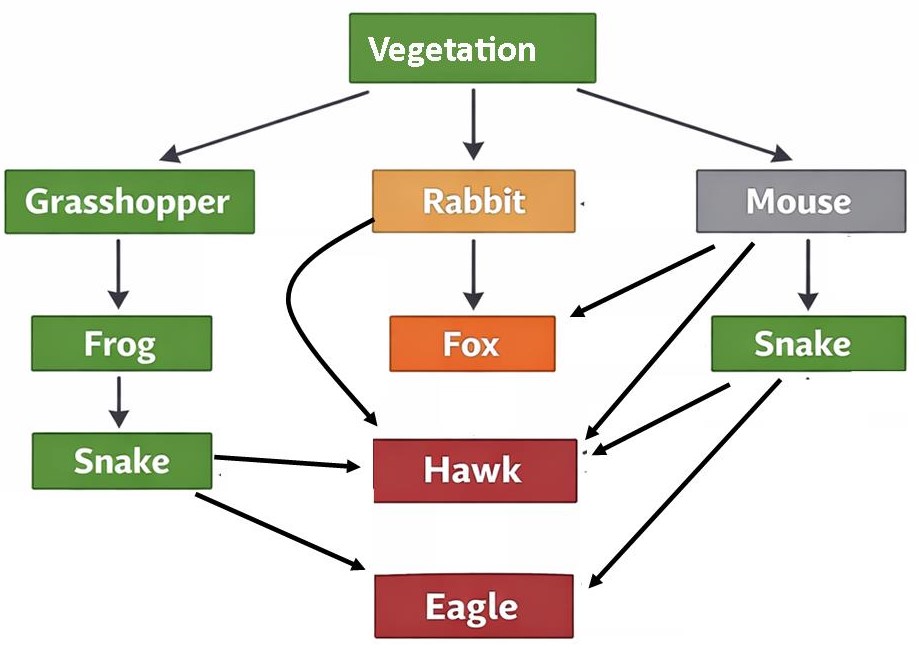
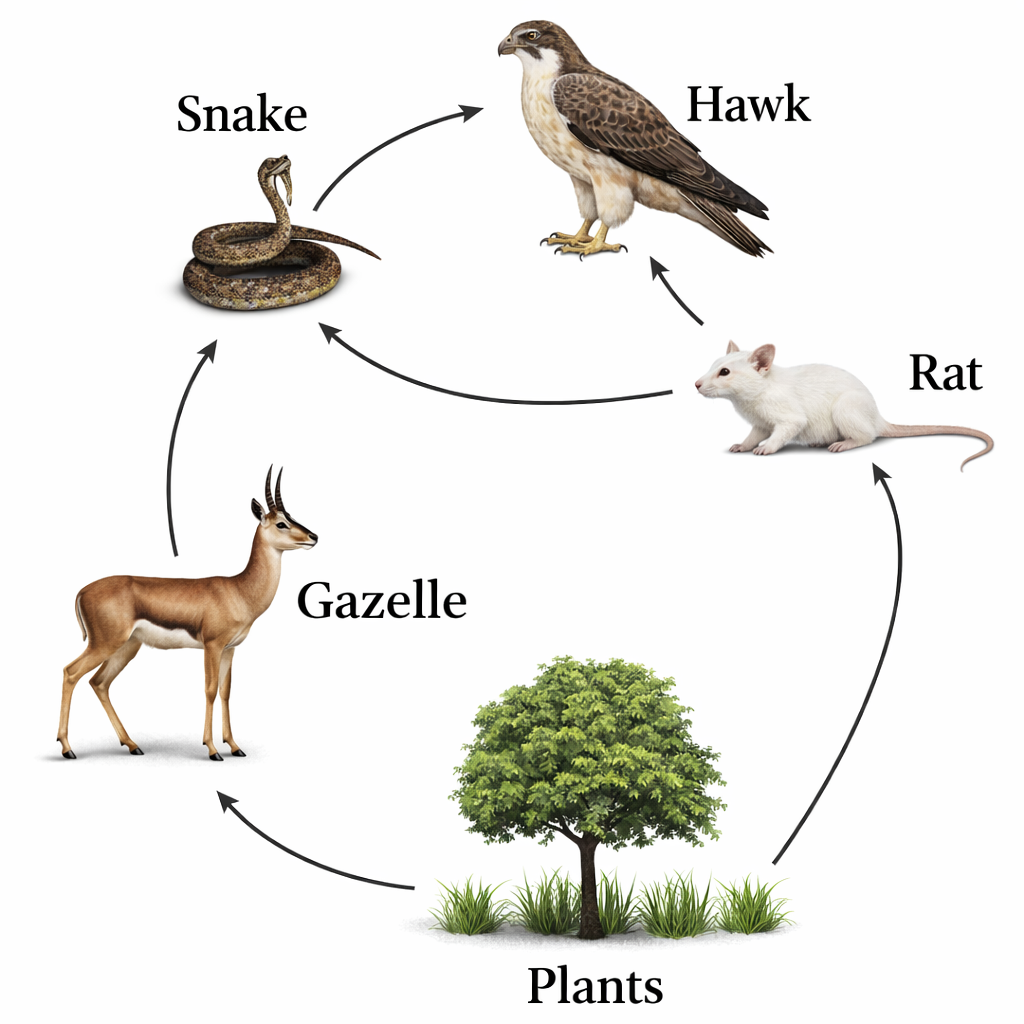
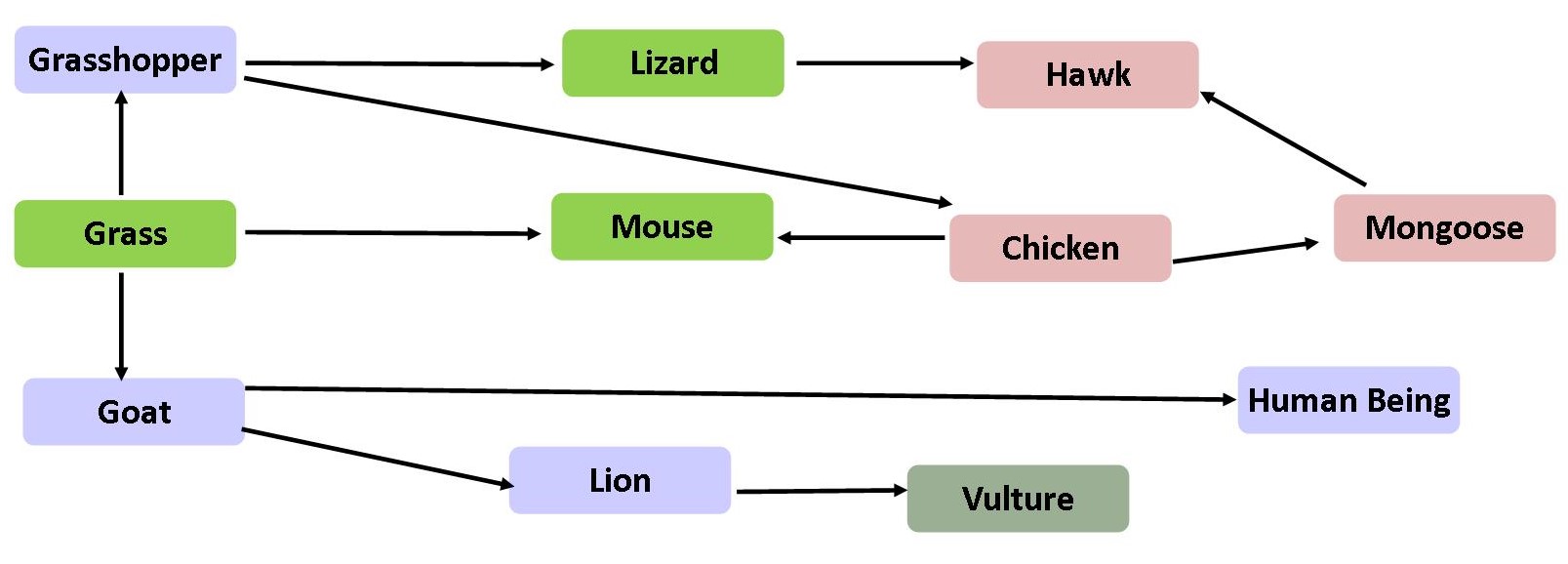
Food webs help to:
- Show the interactions between many organisms
- Demonstrate alternative food sources for organisms
- Increase stability of ecosystems because organisms have multiple food options
Effects of Human Activities on the Environment
.human-section h3{
color:#c23b3b;
border-left:6px solid #ff9e9e;
padding-left:10px;
margin-bottom:12px;
}
.human-box{
background:#fff5f5;
border-left:5px solid #ff9e9e;
padding:16px;
border-radius:10px;
margin:18px 0;
}
.human-box h4{
color:#a83232;
margin-bottom:10px;
}
.effect-box{
background:#fffafa;
border-left:4px solid #ffbdbd;
padding:14px;
border-radius:8px;
margin:14px 0;
}
.effect-box h5{
color:#b83a3a;
margin-bottom:6px;
}
ul{
padding-left:20px;
margin-top:8px;
}
li{
margin-bottom:6px;
}
2.4.3 Effects of Human Activities on the Environment
Human activities can significantly affect the environment. Some of these activities may improve environmental conditions, while others may cause serious damage to ecosystems.
However, many human activities negatively affect natural environments and disrupt ecological balance.
Negative Effects of Human Activities
1. Deforestation
Deforestation involves cutting down forests to create land for agriculture, settlements, or industries.
Effects:
- Loss of habitats for plants and animals
- Reduction in biodiversity
- Increased soil erosion
- Disruption of ecosystems
💡 Did You Know?
Forests help regulate Earth’s climate. Trees absorb carbon dioxide from the atmosphere
and release oxygen, making forests one of the most important natural systems for controlling global warming.
2. Air Pollution
Air pollution occurs when harmful gases and particles are released into the atmosphere by industries, vehicles, and burning fossil fuels.
Effects:
- Respiratory diseases in humans and animals
- Formation of smog
- Contribution to global warming
3. Water Pollution
Water pollution occurs when waste products such as chemicals, sewage, and industrial waste enter rivers, lakes, or oceans.
Effects:
- Harm to aquatic organisms
- Unsafe drinking water
- Spread of waterborne diseases
4. Habitat Destruction
Urban development, agriculture, and infrastructure development may destroy natural habitats.
Effects:
- Animals lose their homes
- Species may become endangered or extinct
- Ecosystems become unstable
Importance of Interdependence
.importance-section h3{
color:#c23b3b;
border-left:6px solid #ff9e9e;
padding-left:10px;
margin-bottom:12px;
}
.importance-box{
background:#fff5f5;
border-left:5px solid #ff9e9e;
padding:16px;
border-radius:10px;
margin:18px 0;
}
.importance-box h4{
color:#a83232;
margin-bottom:10px;
}
.list-box{
background:#fffafa;
border-left:4px solid #ffbdbd;
padding:14px;
border-radius:8px;
margin:14px 0;
}
.list-box h5{
color:#b83a3a;
margin-bottom:6px;
}
ul{
padding-left:20px;
margin-top:8px;
}
li{
margin-bottom:6px;
}
2.4.4 Importance of Interdependence
Interdependence between living and non-living components of the environment is essential for maintaining balanced ecosystems. Each organism plays a role that contributes to the survival of others.
Through interdependence, nutrients and energy move through ecosystems and support life.
Interdependence Ensures:
- Survival of organisms
- Balanced ecosystems
- Recycling of nutrients
- Stability of food chains and food webs
Examples of Interdependence
Living organisms depend on:
- Plants for food and oxygen
- Animals for pollination and seed dispersal
- Abiotic factors such as water, sunlight, and soil nutrients
Because of these relationships, no organism can survive completely on its own. The survival of each organism depends on many others within its environment.
Summary
Interdependence of Life
- Interdependence occurs when organisms depend on one another for survival.
- Living organisms interact with both living and non-living components of the environment.
- These relationships maintain balance and stability in ecosystems.
Biotic Components
- Biotic components are the living parts of the environment.
- Examples include plants, animals, humans and microorganisms.
- They interact through feeding relationships, competition and cooperation.
Abiotic Components
- Abiotic components are the non-living parts of the environment.
- Examples include water, temperature, light and soil pH.
- These factors influence survival, growth and distribution of organisms.
Predation
- Predation occurs when one organism hunts and eats another.
- The hunter is called the predator and the hunted organism is the prey.
- Predation helps regulate population sizes in ecosystems.
Competition
- Competition occurs when organisms struggle for limited resources.
- Resources include food, water, space, shelter and light.
- Competition may occur within the same species or between different species.
Parasitism
- Parasitism is a relationship where one organism benefits while the other is harmed.
- The benefiting organism is the parasite.
- The organism affected is the host.
Symbiosis
- Symbiosis is a close relationship between two organisms.
- Mutualism benefits both organisms.
- Commensalism benefits one organism without harming the other.
Food Chains
- A food chain shows how energy flows from one organism to another.
- Energy begins with producers and moves through consumers.
- Producers, primary consumers, secondary consumers and tertiary consumers form different levels.
Food Webs
- A food web is a network of interconnected food chains.
- It shows multiple feeding relationships between organisms.
- Food webs increase ecosystem stability.
Human Impact on Ecosystems
- Human activities can disrupt ecosystems.
- Examples include deforestation, pollution and habitat destruction.
- These activities reduce biodiversity and destabilize ecosystems.
Importance of Interdependence
- Ensures survival of organisms.
- Supports recycling of nutrients.
- Maintains balance within ecosystems.
- Stabilizes food chains and food webs.
Assessment
Interdependence of Life Assessment
Answer all 20 questions about ecosystems, food chains and environmental interactions.
20 Questions
Certificate of Achievement
This certifies that
has successfully completed the assessment on
Interdependence of Life
Score:
🔎 Grade 9 Integrated Science Navigator
Structure of Atom
Metals and Alloys
Water Hardness
Nutrition in Plants
Nutrition in Animals
Reproduction in Plants
Interdependence of Life
Curved Mirrors
Waves