3.4 Volume and Capacity
Volume
Definition
Volume is the space occupied by matter, or enclosed by a surface.
The SI unit of volume is cubic metre (m³).
Other units include cubic centimetres (cm³).
Notes
1 m³ = 1 m × 1 m × 1 m
1 m = 100 cm
1 m³ = 100 cm × 100 cm × 100 cm
1 m³ = 1 000 000 cm³
Example 3.19
Convert 100 cm³ to cubic metres.
Answer: 0.0001 m³
Example 3.20
Convert 0.2 m³ to cubic centimetres.
Answer: 200 000 cm³
Volume of Objects
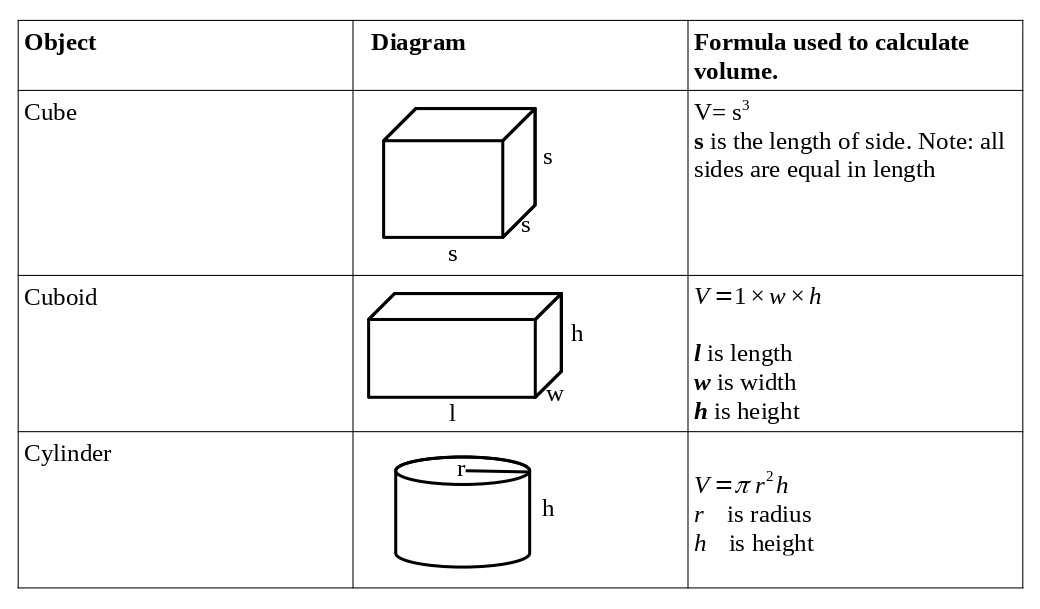
The table below shows the formulae used in calculating volumes of cubes, cuboids and cylinders.
Example 3.21
Calculate the volume of a cube of side 5 cm.
Solution
Volume of cube with side 5 cm = 125 cm³
Example 3.22
Calculate the volume of the cuboid measuring 140 cm by 30 cm by 70 cm in cubic metres.
Solution
Volume of cuboid =1.4×0.3×0.7 = 0.294 m³
Example 3.23
A cylindrical tank has a diameter of 140 cm and a height of 450 cm.
Calculate the volume of the tank in cubic centimetres.
Solution
The diameter is 140 cm, therefore the radius is 70 cm.
V = πr²h
V = (22/7) × 70 cm × 70 cm × 450 cm
V = 6,930,000 cm³
Capacity
Definition
Capacity is the amount of substance a container can hold.
Capacity in fluids (liquids and gases) is measured in litres.
Notes
1 litre = 1000 millilitres
1 millilitre = 1 cm³
1 litre = 1000 cm³
1000 litres = 1 m³
Example 3.24
What volume in cubic centimetres is equivalent to 2 litres?
Solution
2 litres = 2000 cm³
Example 3.25
A tank whose base is a rectangle of dimensions 2 metres by 4 metres has a height of 0.5 metres. What is the capacity of the tank in litres?
Solution
We first obtain the volume in cubic metres.
V = l × w × h
V = 4 m × 2 m × 0.5 m
V = 4 m³
We now convert the volume to capacity.
1 m³ = 1000 litres
4 m³ = x
x = (4 m³ × 1000 litres) / 1 m³
x = 4000 litres
Exercise 3.4
1. Convert each into cubic centimetres.
(a) 2.5 m³
(b) 0.89 m³
(c) 1.43 m³
(d) 0.0052 m³
Multiply each value by 1 000 000 because 1 m³ = 1 000 000 cm³.
2. Convert each to cubic metres.
(a) 3500 cm³
(b) 4050 cm³
(c) 2500 cm³
(d) 150 cm³
Divide each value by 1 000 000 because 1 m³ = 1 000 000 cm³.
3. Convert each to litres.
(a) 450 cm³
(b) 1.03 m³
(c) 63000 cm³
(d) 150 m³
Use: 1 litre = 1000 cm³ and 1 m³ = 1000 litres.
4. Convert to cubic metres.
(a) 2000 litres
(b) 350 litres
Divide litres by 1000 because 1000 litres = 1 m³.
5. Convert to cubic centimetres.
(a) 100 litres
(b) 45 litres
(c) 200 millilitres
(d) 10000 millilitres
1 litre = 1000 cm³ and 1 ml = 1 cm³.
6. Convert to litres.
(a) 200 ml
(b) 4000 ml
Divide millilitres by 1000.
7. Calculate the volume of a cube whose side is 6 cm.
V = s³ = 6 × 6 × 6 = 216 cm³.
8. Calculate the volume of a cylinder of radius 70 cm and height 1 m. (Answer in m³)
Convert radius: 70 cm = 0.7 m
V = πr²h = 22/7 × (0.7)² × 1 = 1.54 m³.