3.2.2 PERIMETER OF PLANE FIGURES
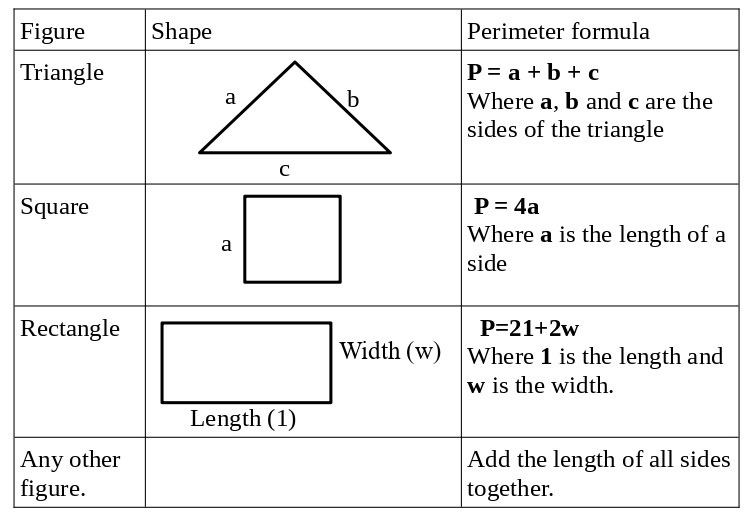
Perimeter is the distance around a figure.
The table below shows the formulae used to find the perimeter of different plane figures.
Example 3.5
A rectangle has a length of 8 cm and a width of 4 cm.
Calculate its perimeter.
Solution
P = 2l + 2w
P = 2 × 8 + 2 × 4
P = 16 + 8
P = 24 cm
Example 3.6
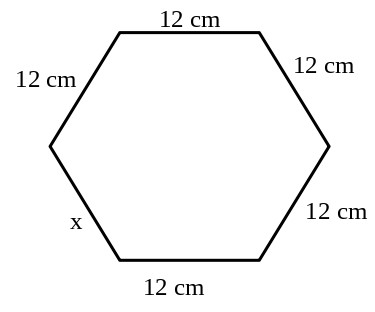
The figure below has a perimeter of 74 cm.
Calculate the length of the side marked x.
Solution
12 cm + 12 cm + 12 cm + 12 cm + 12 cm + x = 74 cm
60 cm + x = 74 cm
x = 74 cm − 60 cm
x = 12 cm
Compare Perimeters Activity (Grade 7)
Enter measurements so the triangle, rectangle, and square all have the
same perimeter. Then click Compare Perimeters.
Triangle
Rectangle
Square
Enter values, then click the button.
Exercise
Use the Check Answers tab to enter answers. Use the Show Working tab to view the steps for each question.
1. The perimeter of a rectangular sheet is 100 cm. If the length is 35 cm, find its width.
cm
Enter your answer and click Check.
2. A person walks round a square field and covers a distance of 3496 m. Find the side of the square field.
m
Enter your answer and click Check.
3. A rectangle has a width of 6 cm and a diagonal of 10 cm. Calculate its perimeter.
First find the length using Pythagoras, then use P = 2(l + w).
cm
Enter your answer and click Check.
4. The perimeter of a rectangle is 84 cm. If the length is 25 cm, find its width.
cm
Enter your answer and click Check.
5. A rectangular garden is 40 m long and 18 m wide. Find its perimeter.
m
Enter your answer and click Check.
Tip: If one is wrong, go to the Show Working tab and check the steps for that question.
Working for Question 1
- Perimeter of a rectangle:
P = 2(l + w) - Substitute:
100 = 2(35 + w) - Divide by 2:
50 = 35 + w w = 50 − 35 = 15- Width = 15 cm
Working for Question 2
- Perimeter of a square:
P = 4s - Substitute:
3496 = 4s - Divide by 4:
s = 3496 ÷ 4 = 874 - Side = 874 m
Working for Question 3
- Use Pythagoras:
l² + w² = d² - Substitute:
l² + 6² = 10² l² + 36 = 100sol² = 64l = √64 = 8- Perimeter:
P = 2(l + w) = 2(8 + 6) = 28 - Perimeter = 28 cm
Working for Question 4
- Perimeter of a rectangle:
P = 2(l + w) - Substitute:
84 = 2(25 + w) - Divide by 2:
42 = 25 + w w = 42 − 25 = 17- Width = 17 cm
Working for Question 5 (Use π = 22/7)
- Circumference:
C = 2πr C = 2 × (22/7) × 35 = 220cm- Distance in 20 revolutions:
20 × 220 = 4400cm - Convert to metres:
4400 ÷ 100 = 44m - Distance = 44 m
Working for Question 6
- Perimeter:
P = 2(l + w) - Substitute:
P = 2(40 + 18) P = 2 × 58 = 116- Perimeter = 116 m