Understanding Mixtures and Methods of Separation
Explore the different types of mixtures, their properties, and methods of separation, including distillation, crystallization, sublimation, and more.
Introduction
A mixture is a combination of two or more substances that are not chemically bonded and can be separated by physical methods. 💡 Fun Fact Mixtures are common in everyday life, such as air, smoothies, and even the sand at the beach!
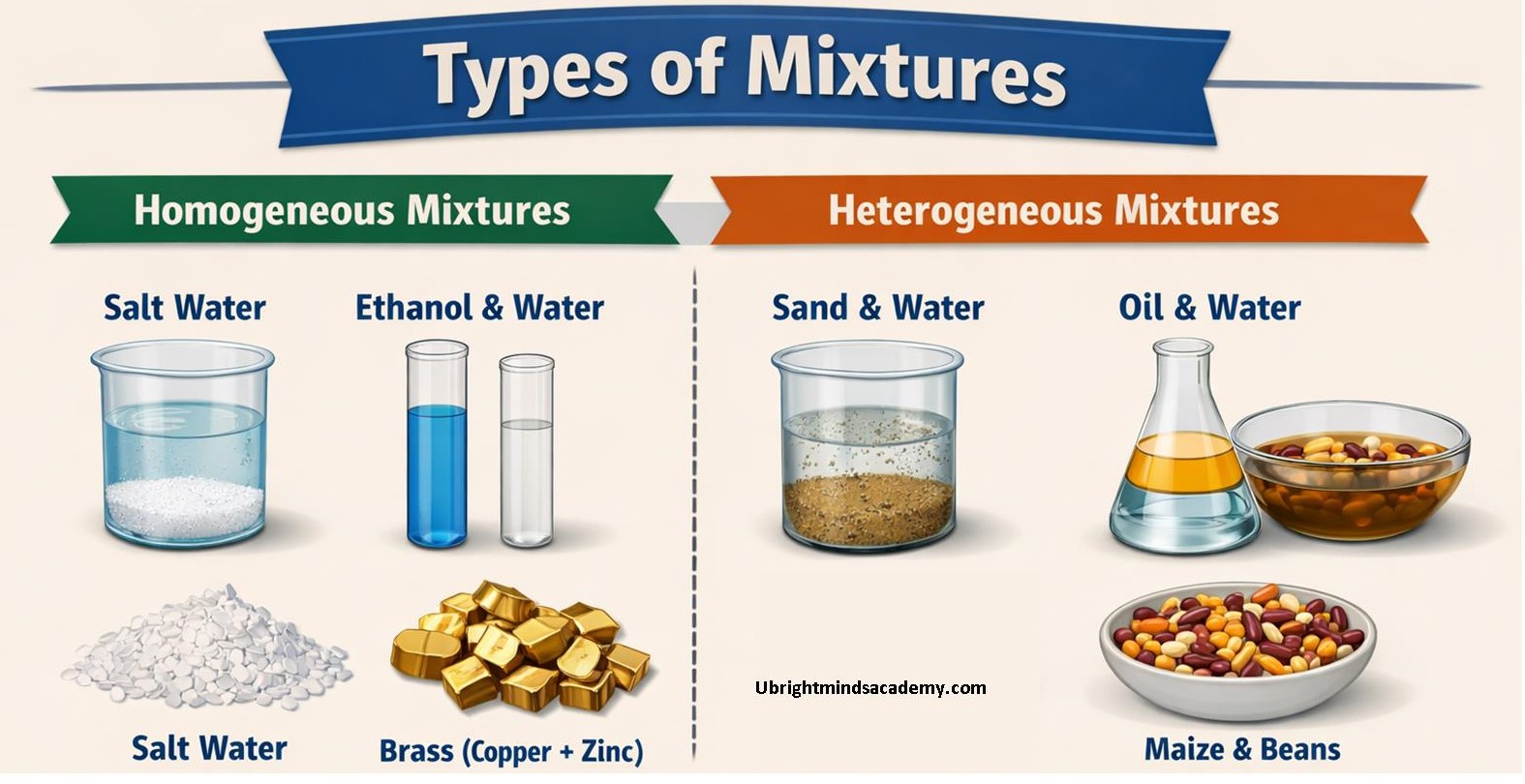
Homogeneous mixtures: This is a mixture whose composition is uniform throughout. Example: salt dissolved in water, brass (copper + zinc). 💡 Did you know? Brass is an alloy made by combining copper and zinc, forming a homogeneous mixture!
Heterogeneous mixtures: This is a mixture whose composition is not uniform. Example: oil and water, sand and water. 💡 Fact In heterogeneous mixtures, you can often see the different components, like sand in water!
Mixtures
Solid–Liquid Mixtures
| Mixture | Type |
|---|---|
| Salt + Water | Homogeneous (soluble) |
| Sugar + Water | Homogeneous (soluble) |
| Sand + Water | Heterogeneous (insoluble) |
| Flour + Water | Heterogeneous (insoluble) |
| Charcoal Powder + Water | Heterogeneous (insoluble) |
Liquid–Liquid Mixtures
| Mixture | Type |
|---|---|
| Ethanol + Water | Homogeneous |
| Distilled Water + Cooking Oil | Heterogeneous |
| Orange Juice + Water | Homogeneous |
| Vinegar + Water | Homogeneous |
| Distilled Water + Ink | Homogeneous |
| Distilled Water + Kerosene | Heterogeneous |
Solid–Solid Mixtures
| Mixture | Type |
|---|---|
| Maize + Beans | Heterogeneous |
| Sand + Common Salt | Heterogeneous |
| Sulphur + Iron Filings | Heterogeneous |
| Cement | Homogeneous |
| Brass (Copper + Zinc) | Homogeneous |
Solvent, Solute, and Solution
Solute: Substance that dissolves (e.g., sugar, salt). 💡 Did you know? Sugar is a solute that dissolves well in water to form a homogeneous solution!
Solvent: Liquid that dissolves the solute (e.g., water). 💡 Fun Fact Water is called the "universal solvent" because it dissolves more substances than any other liquid!
Solution: Homogeneous mixture formed (e.g., sugar solution, salty water). 💡 Fact A solution is a homogeneous mixture where the solute is completely dissolved in the solvent!
Separation of Mixtures
1. Simple Distillation
Definition:
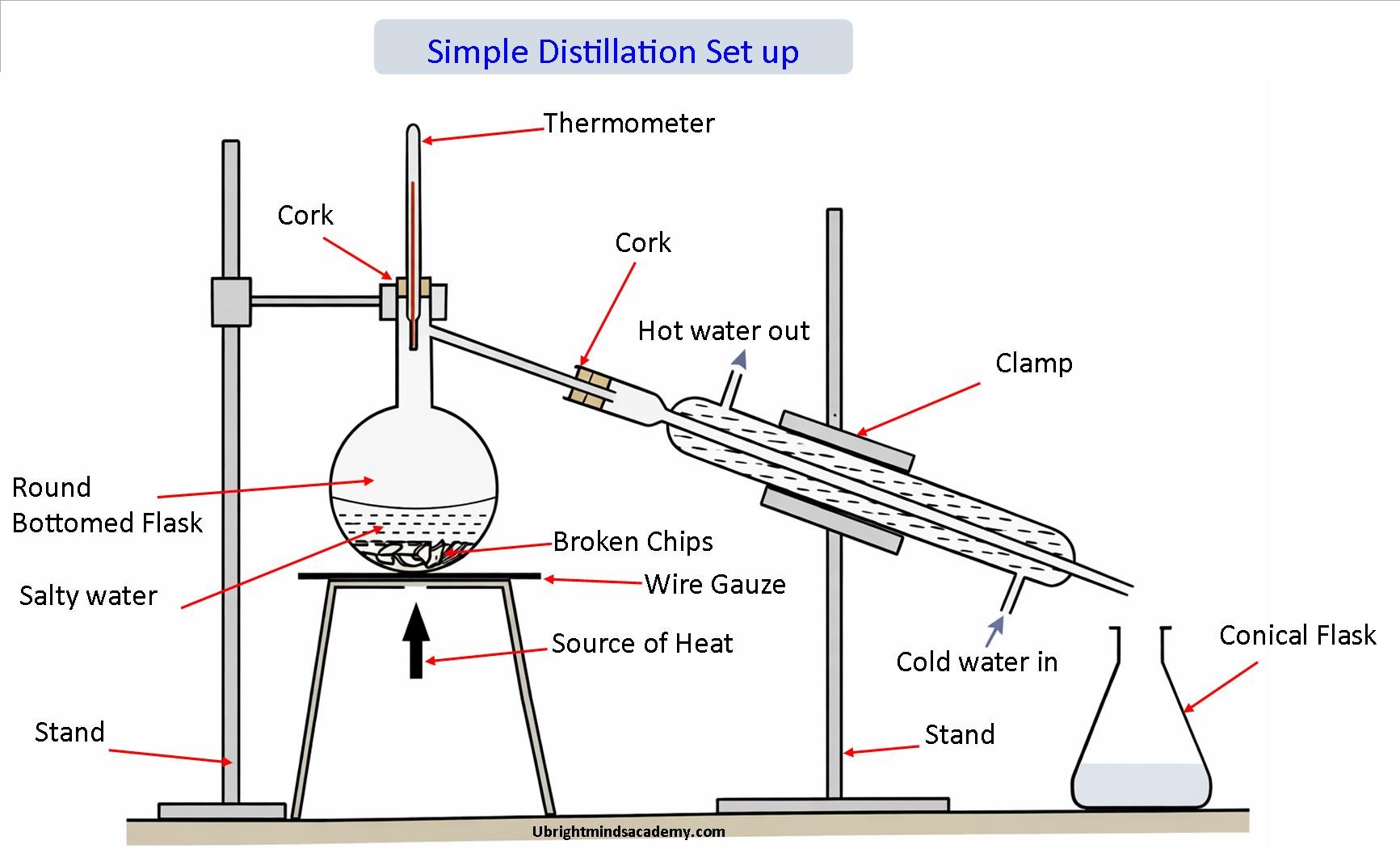
Simple distillation is a method used to separate a solvent from a solution based on differences in boiling points. It is most suitable for homogeneous solid–liquid mixtures where the solid does not evaporate. It is also suitable for homogeneous liquid-liquid mixtures for liquids of different boiling points.
Purpose / Used to separate:
- Homogeneous liquid-liquid mixtures with different boiling points.
Example: Separating acetone from water (acetone boils at 56°C, water at 100°C).
Apparatus:
- Distillation flask (contains the mixture)
- Heat source (Bunsen burner or electric heater)
- Condenser (to cool and condense the vapor)
- Receiving flask (to collect the distilled liquid)
- Thermometer
- Broken porcelain or boiling chips
Procedure:
i. Pour the liquid mixture (acetone + water) into the distillation flask.
ii. Add broken porcelain / boiling chips to the flask. Prevent sudden vigorous boiling (“bumping”) which can cause splashing.
iii. Heat the flask slowly.
iv. Acetone evaporates first because it has a lower boiling point (56°C).
v. The vapor passes into the condenser, where it cools and condenses into a liquid.
vi. Collect the condensed liquid (acetone) in the receiving flask.
vii. This liquid is pure acetone, separated from water.
Key Points / Observations:
- The separation works because acetone has a lower boiling point than water.
- Broken porcelain prevents bumping during heating.
- The remaining liquid in the distillation flask is mostly water.
- This method can be applied to any mixture of liquids with significantly different boiling points.
Applications:
- Obtaining drinking water from salt water.
- Purifying water in laboratories.
- Separating alcohol from aqueous solutions (when using fractional distillation for closer boiling points).
2. Crystallisation
Definition:
Crystallisation is a method used to obtain pure solid crystals from a saturated solution. It is commonly used for homogeneous solid–liquid mixtures where the solute can form crystals on cooling or evaporation of the solvent.
Purpose / Used to separate:
- Homogeneous solid–liquid mixtures
Example: Obtaining copper (II) sulphate crystals from its solution.
Apparatus:
- Beaker or crystallisation dish
- Glass rod
- Heat source (Bunsen burner or water bath)
- Filter paper and funnel (optional, for removing impurities)
Procedure:
i. Prepare a saturated solution by dissolving the solute (e.g., copper (II) sulphate) in the minimum amount of hot solvent (water).
ii. Filter the solution if necessary to remove insoluble impurities.
iii. Pour the solution into a crystallisation dish.
iv. Allow the solution to cool slowly.
v. Dip a glass rod into the solution to check if it is saturated and to initiate crystal formation (seeding).
vi. As the solution cools, the solute crystallises out, forming pure crystals on the surface or at the bottom.
vii. Carefully collect the crystals and dry them using filter paper.
Key Points / Observations:
- Seeding: Dipping a glass rod provides a nucleation point for crystal growth.
- Purity: Only pure solute forms crystals; impurities remain in the solution (mother liquor).
- Slow cooling produces larger, well-formed crystals.
- Type of mixture separated: Homogeneous solid–liquid mixture.
- Result: Pure crystals of the solute, separated from the solvent.
Applications:
- Obtaining pure copper (II) sulphate crystals in the lab.
- Purifying sugar or salt.
- Producing pure chemical compounds in chemistry experiments.
3. Sublimation
Definition:
Sublimation is a method used to separate a solid–solid mixture in which one solid sublimes (changes directly from solid to gas) while the other does not.
Purpose / Used to separate:
- Solid–solid mixtures where one solid is volatile and can sublime.
Example: Separating iodine from salt.
Apparatus:
- Conical flask or beaker (contains the mixture)
- Round-bottomed flask or inverted funnel (to collect sublimed solid)
- Heat source (Bunsen burner or water bath)
- Stand and clamp (to hold the apparatus)
Procedure:
i. Place the mixture (e.g., iodine + salt) in a beaker.
ii. Set up a round-bottomed flask or inverted funnel above the mixture to collect the sublimed solid.
iii. Heat the mixture gently.
iv. Iodine sublimes (solid → gas) because it is volatile.
v. Salt does not sublimate and remains as a white solid in the beaker.
vi. The iodine gas rises and cools on the surface of the flask or funnel, undergoing deposition (gas → solid).
vii. Collect the purple/black iodine crystals formed on the cooler surface.
Key Points / Observations:
- Sublimation: Direct conversion of solid to gas without becoming liquid.
- Deposition: Gas to solid upon cooling.
- Separation:
- White solid left in beaker → salt
- Coloured solid on flask → iodine
- Useful for purifying solids that sublime.
Applications:
- Purifying iodine from salt.
- Producing mothballs (naphthalene) from mixtures.
- Separating volatile solids from non-volatile solids in labs.
4. Solvent Extraction
Definition:
Solvent extraction is a method used to separate a substance from a mixture based on its solubility in a particular solvent. It is often used to extract desired substances from solids or liquids.
Purpose / Used to separate:
- Separates substances that are soluble in a particular solvent but not in others.
Example: Extracting oil from groundnuts using propanone.
Apparatus:
- Beaker or container (contains the solid mixture, e.g., groundnuts)
- Solvent (e.g., propanone)
- Filter paper (optional, to remove insoluble solid particles)
- Evaporating dish or tray (to recover the extracted substance)
Procedure:
i. Place the solid mixture (e.g., groundnuts) in a beaker.
ii. Add a suitable solvent (e.g., propanone) that dissolves the desired substance (oil).
iii. Stir or shake the mixture to allow maximum dissolution of the oil in the solvent.
iv. Filter the mixture if necessary to remove insoluble solid residue.
v. Allow the solvent to evaporate naturally or gently heat it in an evaporating dish.
vi. The oil remains after the solvent has evaporated.
Key Points / Observations:
- The solvent selectively dissolves the substance to be separated.
- Evaporation of the solvent leaves behind the desired substance.
- Paper test: When oil is applied to paper, it becomes translucent, confirming the presence of oil.
Applications:
- Extracting edible oils from seeds (groundnuts, sunflower, etc.)
- Making perfumes and essential oils
- Extracting plant chemicals for medicines or dyes
5. Paper Chromatography
Definition:
Paper chromatography is a method used to separate the components of a mixture based on their solubility and movement on a special paper. It is commonly used for analyzing coloured substances like inks, dyes, and plant pigments.
Purpose:
- Used to separate components of a homogeneous mixture based on solubility and adsorption.
Example: Separating ink dyes into individual colours.
Apparatus:
- Chromatography paper (filter paper or special strip)
- Beaker or container
- Solvent (e.g., water, alcohol)
- Pencil (to draw baseline)
- Capillary tube or dropper (to place sample)
Procedure:
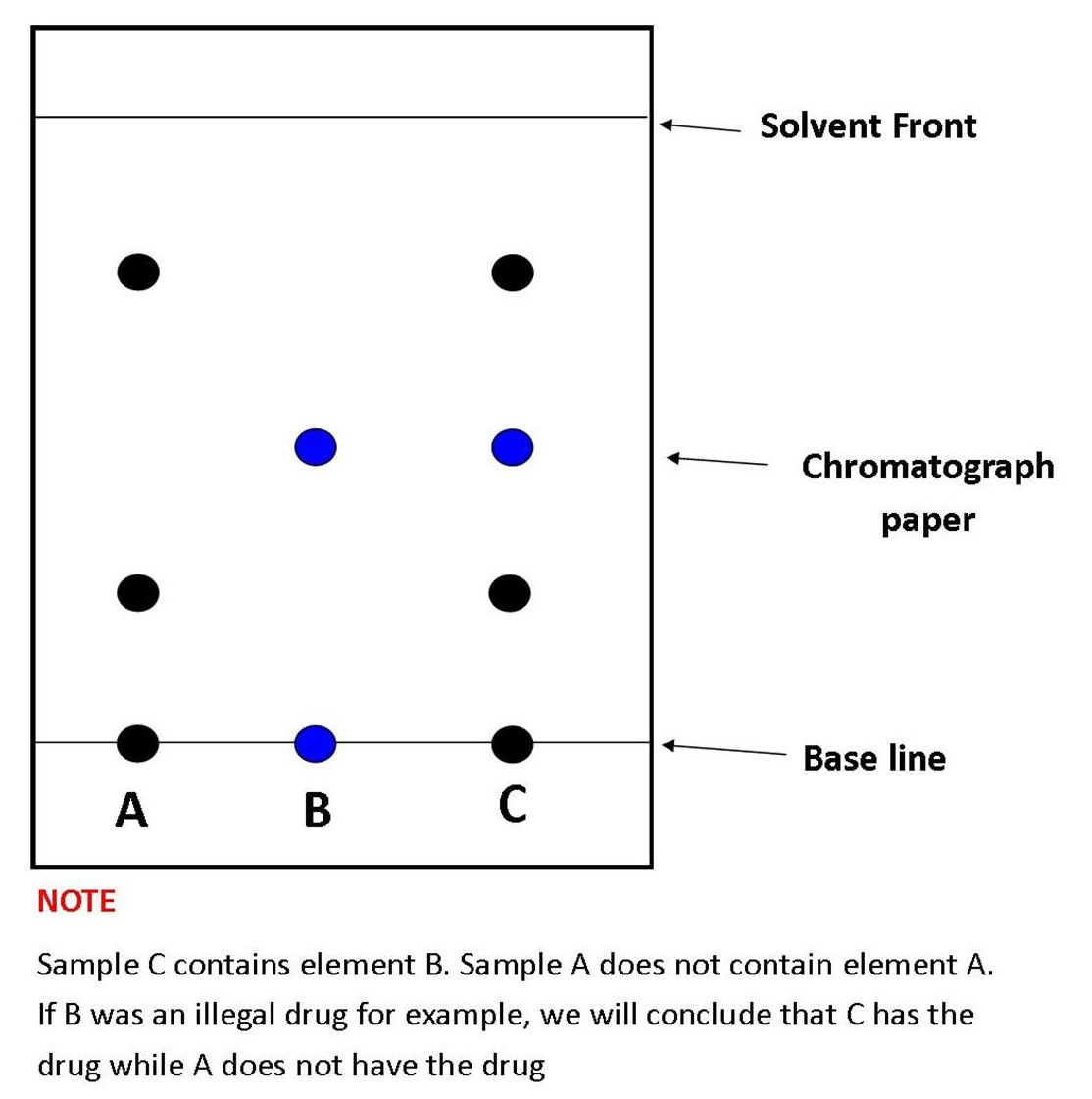
i. Draw a baseline near the bottom of the chromatography paper using a pencil.
ii. Place a small drop of the mixture (e.g., black ink) on the baseline.
iii. Place the paper in a beaker containing a small amount of solvent, ensuring the baseline is above the solvent level.
iv. Allow the solvent to rise up the paper by capillary action, carrying the components of the mixture with it.
v. Observe the separation of components:
vi. Most soluble component moves furthest up the paper.
vii. Least soluble component remains near the baseline.
viii. Remove the paper once the solvent front reaches a desired height and allow it to dry.
Key Points / Observations:
- The method works because different components have different solubility and attraction to the paper.
- Separation is visible as different coloured spots on the paper.
- Distance travelled by a component depends on its solubility in the solvent.
Applications:
- Detecting illegal drugs in athletes
- Separating and identifying food colourings
- Forensic investigations (e.g., analysing inks, blood pigments)
- Studying plant pigments and chemical composition
6. Evaporation
Meaning:
Evaporation is a method used to separate a solvent from a solution by heating or leaving it exposed to air. It is used to separate a solvent from a solution.
Example: Obtaining salt from sea water. When sea water is heated or left in shallow ponds under the sun, the water evaporates and salt crystals remain.
Key Points:
- The liquid (solvent) changes into vapor.
- The solid (solute) remains behind as crystals.
- Evaporation occurs faster when:
- Temperature is high
- Surface area is large
- Wind is blowing
Other Applications:
- Drying grains after harvesting.
- Drying clothes under the sun.
- Making salt in salt pans.
7. Fractional Distillation
Meaning:
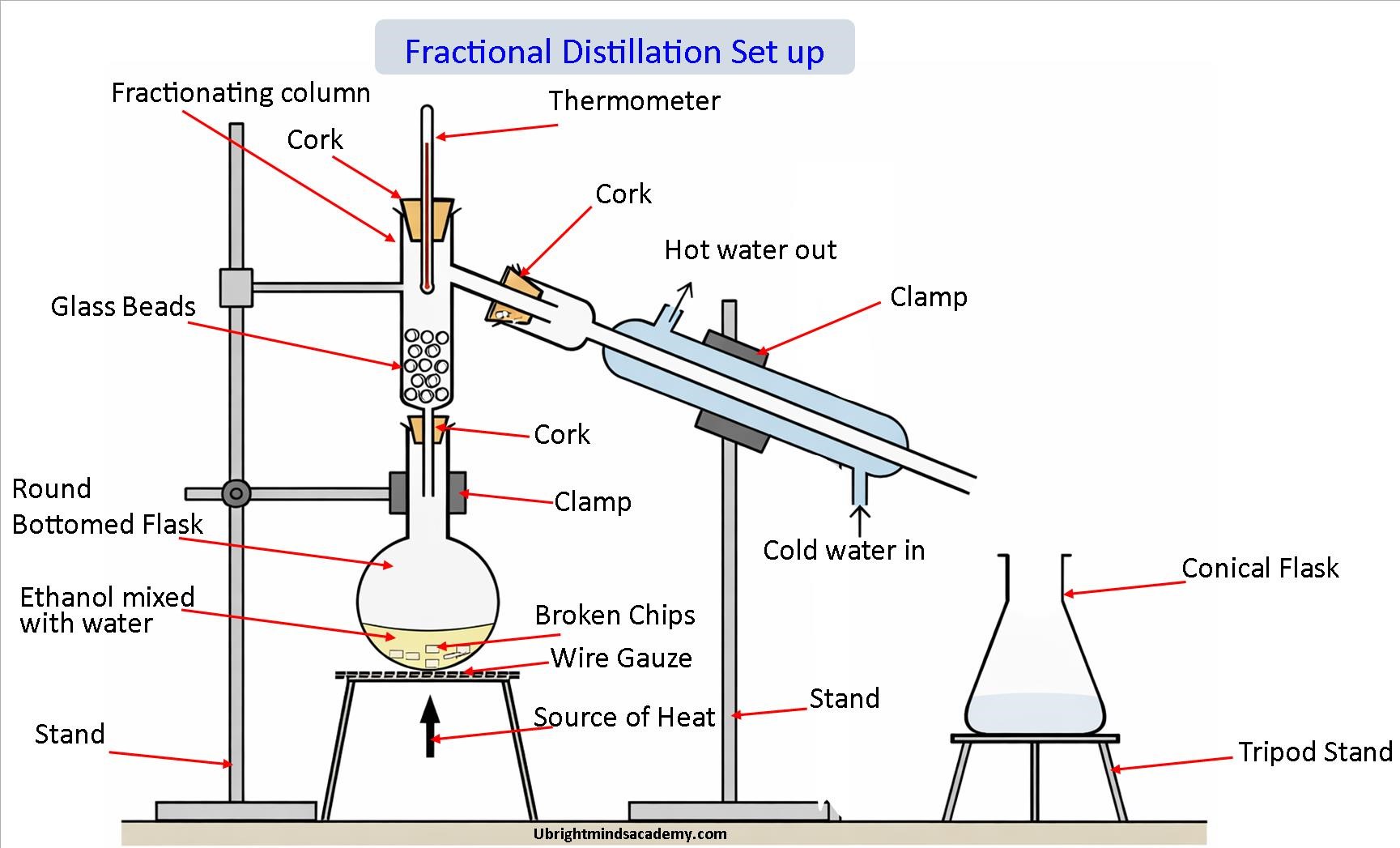
Fractional distillation is a method used to separate two or more liquids that are miscible (mixed together) and have close boiling points. It is used to separate liquids with close boiling points.
Example: Separating ethanol from water and refining crude oil into useful products such as petrol, diesel, and kerosene.
Key Points:
- Separation is based on differences in boiling points.
- Ethanol boils at about 78°C, while water boils at 100°C.
- The liquid with the lower boiling point evaporates first.
- A fractionating column is used to improve separation.
- In oil refining, different fractions are collected at different temperatures.
Products from Crude Oil:
- Petrol (gasoline)
- Kerosene
- Diesel
- Lubricating oil
- Bitumen
Summary
Introduction to Mixtures
- A mixture is a combination of two or more substances that are not chemically bonded and can be separated by physical methods.
- Homogeneous mixtures have a uniform composition, while heterogeneous mixtures do not.
- Examples: Salt dissolved in water (homogeneous), oil and water (heterogeneous).
Types of Mixtures
- Solid–Liquid Mixtures: Examples include salt + water (homogeneous) and sand + water (heterogeneous).
- Liquid–Liquid Mixtures: Examples include ethanol + water (homogeneous) and distilled water + cooking oil (heterogeneous).
- Solid–Solid Mixtures: Examples include maize + beans (heterogeneous) and cement (homogeneous).
Solvent, Solute, and Solution
- Solute: The substance that dissolves (e.g., sugar, salt).
- Solvent: The liquid that dissolves the solute (e.g., water).
- Solution: A homogeneous mixture formed by the solute dissolving in the solvent (e.g., sugar solution, salty water).
Separation of Mixtures
- Simple distillation: Used for separating liquids with different boiling points, like acetone and water.
- Crystallisation: Used to obtain pure solid crystals from a saturated solution.
- Sublimation: Separates solid–solid mixtures where one solid sublimes (changes from solid to gas).
Simple Distillation
- Definition: A method to separate a solvent from a solution based on differences in boiling points.
- Example: Separating acetone from water.
- Key Points: Works with liquids of significantly different boiling points.
Crystallisation
- Definition: A method to obtain pure solid crystals from a saturated solution.
- Example: Obtaining copper (II) sulphate crystals from a solution.
- Key Points: Purity is achieved by slow cooling; only pure solute forms crystals.
Sublimation
- Definition: A method used to separate solid–solid mixtures, where one solid sublimes.
- Example: Separating iodine from salt.
- Key Points: Sublimation involves direct conversion from solid to gas.
Solvent Extraction
- Definition: A method to separate a substance from a mixture based on its solubility in a solvent.
- Example: Extracting oil from groundnuts using propanone.
- Key Points: Solvent selectively dissolves the substance, and evaporation leaves the desired substance.
Paper Chromatography
- Definition: A method to separate the components of a mixture based on solubility and movement on paper.
- Example: Separating ink dyes into individual colors.
- Key Points: Distance travelled depends on solubility in the solvent used.
Evaporation
- Definition: A method to separate a solvent from a solution by heating or leaving it exposed to air.
- Example: Obtaining salt from sea water.
- Key Points: Evaporation is faster with high temperature, large surface area, and wind.
Fractional Distillation
- Definition: A method to separate two or more liquids with close boiling points.
- Example: Separating ethanol from water or refining crude oil into products like petrol.
- Key Points: Uses differences in boiling points and a fractionating column to improve separation.
Assessment
Water Hardness Assessment
Answer all 20 questions about water hardness, properties of water and softening methods. Your results will be marked automatically.
Certificate of Achievement
This certifies that
has successfully completed the assessment on
Water Hardness
Score: