Integers
Learn the fundamentals of Integers including addition, subtraction, multiplication, division, and combined operations.
Integers
Integers are numbers which can be positive, negative or zero, but cannot be a fraction.
We can say that integers are positive and negative whole numbers, including zero.
Examples: 1, 2, 5, 0, -2, -3, -7, 10
Addition
Addition of Integers
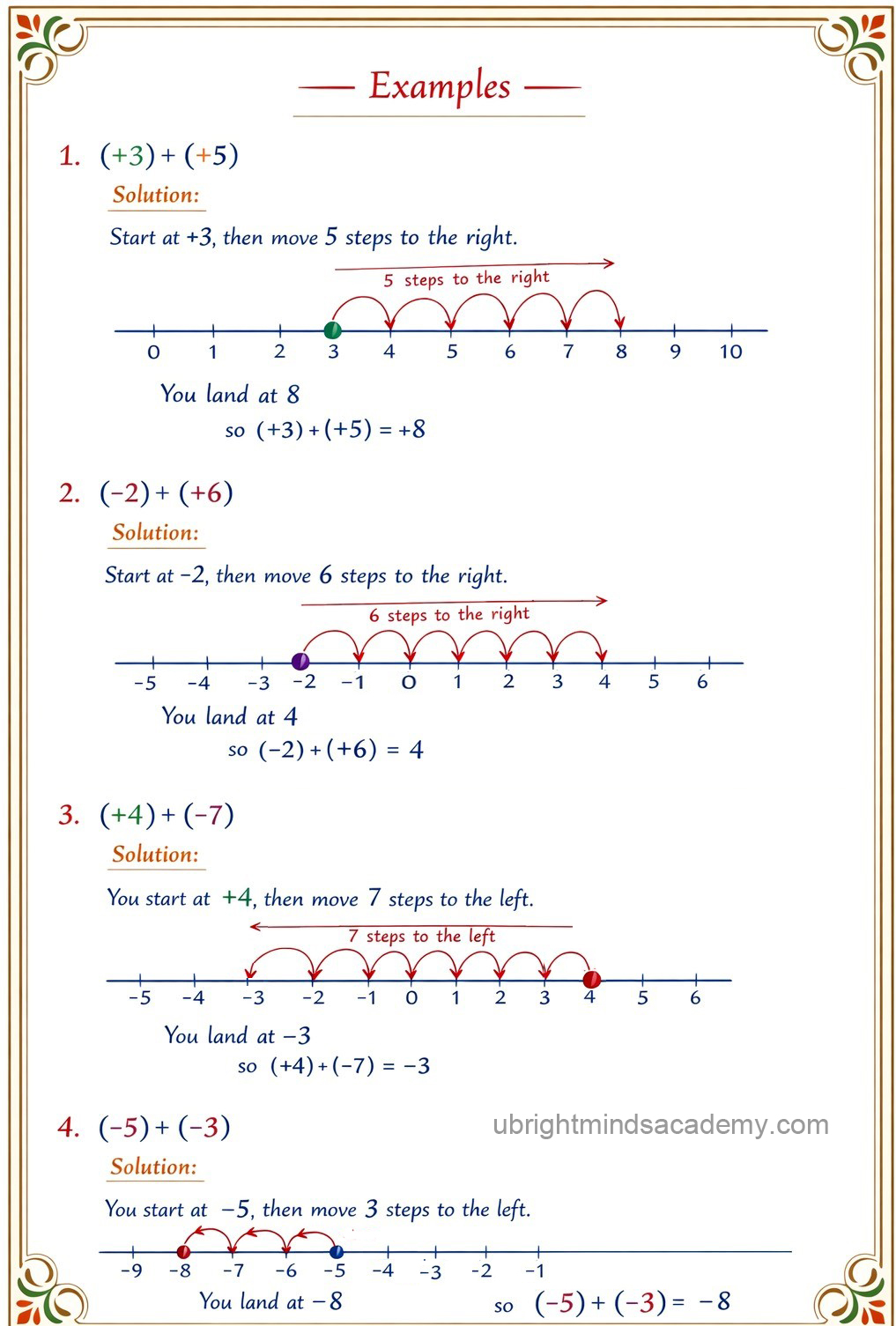
Addition of integers can be shown on a number line.
Rules
- When you add a positive integer, move to the right.
- When you add a negative integer, move to the left.
Important Points to Note
- Adding a positive integer increases the value.
- Adding a negative integer decreases the value.
- If the integers have the same sign, add the numbers and keep the sign.
Example: (-4) + (-2) = -6 - If the integers have different signs, subtract the smaller number from the bigger number and keep the sign of the number with the greater value.
Example: (+7) + (-3) = +4
Subtraction
Subtraction of Integers
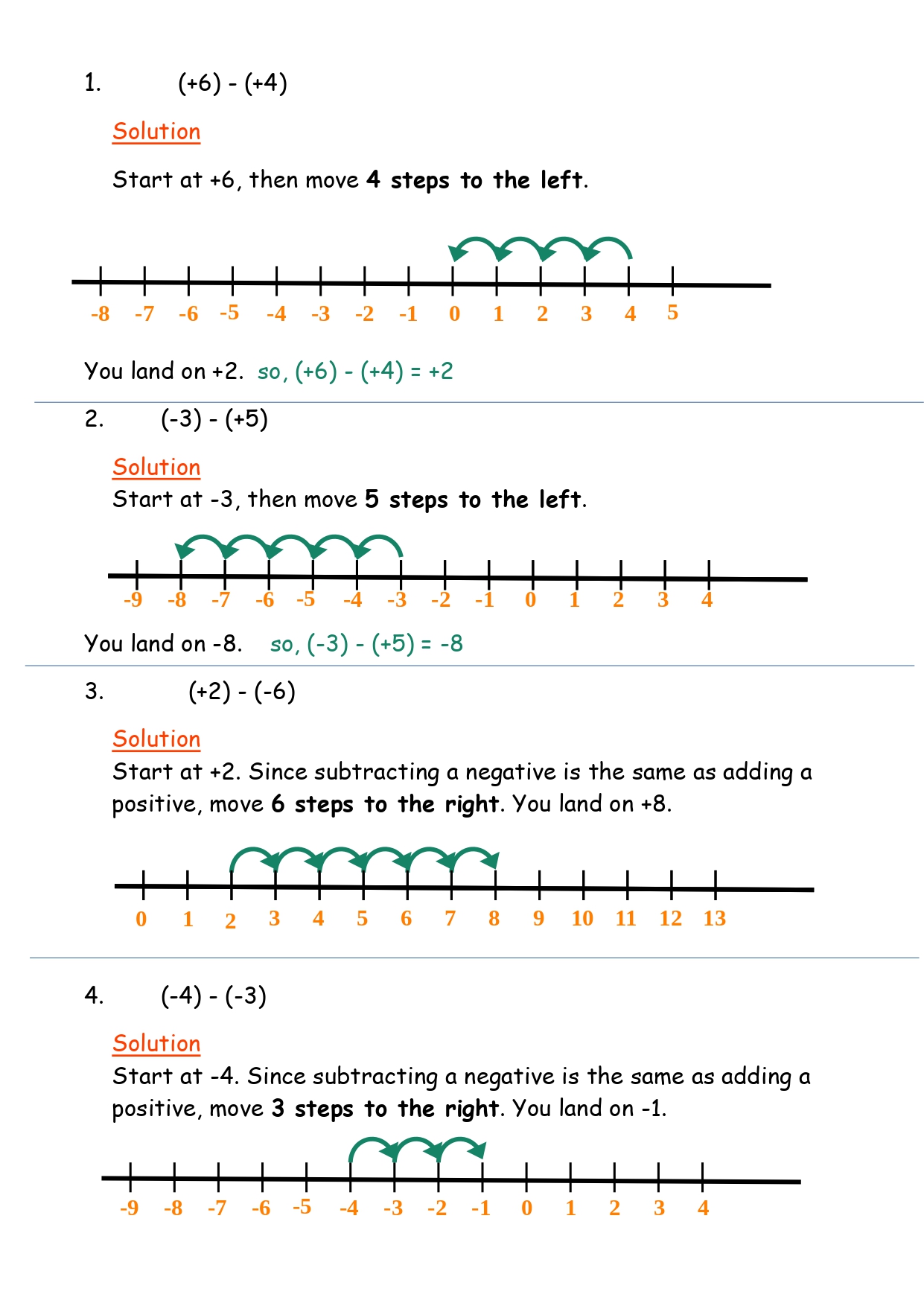
Subtraction of integers can also be shown on a number line.
Rules
- Subtracting a positive number means move left.
- Subtracting a negative number is the same as adding a positive number.
Examples
Important Points to Note
- Subtracting a positive integer makes the number smaller.
- Subtracting a negative integer makes the number larger.
- Always remember:
a – (-b) = a + b
Example: 5 – (-2) = 5 + 2 = 7
Multiplication and Division of Integers
Multiplication and division of integers follow the same sign rule.
When working with integers, first work with the numbers, then decide the sign of the answer.
Combined Sign Rule
- If the integers have the same sign, the answer is positive.
- If the integers have different signs, the answer is negative.
In Simple Words
- Same signs give a positive answer.
- Different signs give a negative answer.
Sign Table for Multiplication and Division
Multiplication of Integers
Multiplication of integers means repeated addition.
When multiplying integers, multiply the numbers as usual and then apply the sign rule.
Examples
-
(+2) × (+3) = +6
Positive two multiplied by positive three equals positive six. -
(-4) × (-5) = +20
Negative four multiplied by negative five equals positive twenty. -
(+6) × (-2) = -12
Positive six multiplied by negative two equals negative twelve. -
(-3) × (+7) = -21
Negative three multiplied by positive seven equals negative twenty-one. -
2 × (-3) = -6
Two multiplied by negative three equals negative six. -
(-4) × (-2) = +8
Negative four multiplied by negative two equals positive eight.
What to Remember in Multiplication
- Multiply the numbers first.
- Then use the sign rule.
- Same signs give a positive answer.
- Different signs give a negative answer.
Division
Division of integers means sharing or grouping equally.
When dividing integers, divide the numbers as usual and then apply the same sign rules as in Multiplication.
Points to Note
- When a positive integer is divided by a positive integer, the result is positive.
- When a negative integer is divided by a negative integer, the result is positive.
- When a positive integer is divided by a negative integer, the result is negative.
- When a negative integer is divided by a positive integer, the result is negative.
Quick Sign Guide
(+ ) ÷ (+ )
Positive result
(- ) ÷ (- )
Positive result
(+ ) ÷ (- )
Negative result
(- ) ÷ (+ )
Negative result
Examples
-
(+12) ÷ (+3) = +4
Positive twelve divided by positive three equals positive four. -
(-20) ÷ (-5) = +4
Negative twenty divided by negative five equals positive four. -
(+18) ÷ (-6) = -3
Positive eighteen divided by negative six equals negative three. -
(-16) ÷ (+4) = -4
Negative sixteen divided by positive four equals negative four. -
6 ÷ (-3) = -2
Six divided by negative three equals negative two. -
-35 ÷ 5 = -7
Negative thirty-five divided by five equals negative seven. -
(-160) ÷ (-8) = 20
Negative one hundred and sixty divided by negative eight equals positive twenty.
What to Remember in Division
- Divide the numbers first.
- Then apply the sign rule.
- Same signs give a positive answer.
- Different signs give a negative answer.
Word Problems on Multiplication and Division
Worked Example
A debt of KSh 840 is shared equally over 7 months.
If the debt is represented by a negative integer, what is the amount paid each month?
Mathematical sentence:
(-840) ÷ 7 = -120
Answer:
The amount is KSh 120 per month.
Combined Operations
enter content here …
Past KJSEA
enter content here …